
The “Foolishness” of God

Adoration of the Shepherds

You are the owner of a baseball team and are in the process of trying to put together the strongest team possible with the goal of winning a championship. As you get ready to select the player to play third base, you have a choice of two players. Both are excellent defensive players, but while one is a power hitter capable of putting up big numbers, the other can barely hit his way out of a paper bag. So you choose the latter, right? … I didn’t think so. Obviously, you choose the accomplished hitter. It’s the most logical choice, the wisest choice.

While the actions and choices of man are based on what makes the most sense, what is wisest in the eyes of others, the actions of God appear to be, from a worldly perspective, foolish. In 1 Corinthians 1:25, the apostle Paul states that God’s foolishness is wiser than men and God’s weakness is stronger than men. In verse 27, Paul goes on to say that God has chosen the things that seem foolish to the world to shame the wise, and the things that the world considers weak, to shame the strong. Paul is talking about the death and resurrection of Christ here, but when you look through the pages of the Bible, you can see that this is the way God has worked throughout time.

When God decided to choose someone to lead His people out of slavery in Egypt, someone to go and present His case to Pharaoh, he didn’t choose someone who was a great orator. He chose Moses, a person who, in his own words, was slow of speech and slow of tongue (Exodus 4:10). When Saul had fallen out of grace as king of Israel and God was leading Samuel to His new choice for king, God didn’t choose the strongest, most experienced leader available. He chose David, a young shepherd boy (1 Samuel 16:11-12). When Jesus chose the twelve men into whom He would pour out His wisdom, the men who would become His disciples and spearhead the foundation of the church, He did not choose the most educated men, such as the scribes and the Pharisees. He chose fishermen, tax collectors, and other common, uneducated men.

God’s “foolishness” is even seen in the story of the first Christmas, when God sent His Son into the world to redeem mankind from sin. God did not choose to send His Son in divine form. He chose instead to send Him in the form of a small, vulnerable human child, born not of a queen but of a young virgin girl named Mary. God did not choose to have His Son born in a palace and placed in a luxurious crib. He chose to have Him born in a stable and placed in a manger, a feeding trough for animals. When God sent His angel messengers to tell of the good news of Jesus’ birth, He did not choose to make that announcement to kings and rulers. He chose to make the announcement to a group of lowly shepherds.

As we reflect on the birth of Jesus this Christmas season, we should remember that God’s ways are greater and higher than our ways and His thoughts are greater and higher than our thoughts (Isaiah 55:9). God can work in the lives of anyone and everyone. He can use the most unlikely person to do His work here on earth. He can use me, and He can use you, no matter what or who we are in the eyes of the world.


The Very First Christmas Carol

Angels

Angels we have heard on high
Sweetly singing o’er the plains;
And the mountains, in reply,
Echoing their joyous strains:

Gloria, in excelsis Deo!

One of the most wonderful parts of the Christmas season is the carols that we begin to hear on a daily basis beginning right after Thanksgiving. Carols are heard through the PA systems at shopping malls, they are played on the radio stations we tune into in our cars, they are played on church organs and sung by choirs and worship teams, and they are played on our sound systems and MP3 players at home. There are many beautiful carols celebrating the birth of our Lord and Savior Jesus Christ. Among them are such beautiful songs like Angels We Have Heard on High, O Holy Night, Silent Night, and O Little Town of Bethlehem. And there are songs that speak of the angels, the shepherds, and the wise men who played a part in the story of the first Christmas.

The words and melodies of these songs are so familiar to all of us that we may often find ourselves singing along with them or humming them as we go about our daily tasks. Most of these beloved carols have been around for a long time. But the very first Christmas carol was sung over 2,000 years ago. The melody of this carol is unknown to us, but we have read or heard its words many times, especially during the Christmas season. It’s a carol that was sung by an angel choir that appeared to a group of shepherds who were tending their flocks in the hills around Bethlehem:

And suddenly there was with the angel a multitude of the heavenly host praising God and saying: “Glory to God in the highest, and on earth peace, goodwill toward men!” (Luke 2:13-14, NKJV)

This first Christmas carol must have been sung with a joy unknown to man. The angels who sang this song were very likely present at the creation of the world and the creation of man, at which time they shouted for joy (Job 38:7). They no doubt had witnessed the fall of man and felt great sorrow as the peace between God and man was shattered. But, now they were tasked with announcing the good news of salvation. God had sent His Son into the world to provide that salvation. The peace between God and His creation was about to be restored. And so, as they delivered this message to the shepherds that night, the joy in their hearts must have been an unspeakable joy.

The words that the angels sang, God’s message for man, spoke to the salvation that Jesus Christ was bringing to the world. In his sermon titled, The First Christmas Carol, delivered on December 20, 1857, the great preacher Charles H. Spurgeon said:

“And what they said of this salvation was this: they said, first, that it gave glory to God; secondly, that it gave peace to man; and, thirdly, that it was a token of God’s good will towards the human race.”

The first words sung by the angel choir were, “Glory to God in the highest.” These are words that they likely had sung many times before as they worshiped God in heaven. But, as they sang them that day, the words probably took on new meaning. The glory of God, which existed for eternity in heaven, had now come to earth in the form of the baby Jesus. God’s glory was present to man in human form. And Jesus was God’s promise of salvation for man, a salvation that ultimately brings glory to God. Because that salvation would remove the veil of sin that separated man from the presence of God, that salvation also brought peace to man. And, as Spurgeon so aptly pointed out, that promise of salvation was “a token of God’s good will towards the human race.”

As we sing and listen to our favorite Christmas carols this Christmas season, let us remember that first Christmas carol, and let our hearts be filled with the same unspeakable joy that filled the hearts of the angel choir who sang it.

Scripture quotations marked NKJV are taken from the New King James Version. Copyright © 1982 by Thomas Nelson, Inc. Used by permission. All rights reserved.

Love Came Down

Love Came Down

Love came down at Christmas,
Love all lovely, Love divine;
Love was born at Christmas,
Star and angels gave the sign.

Worship we the Godhead,
Love incarnate, Love divine;
Worship we our Jesus:
But wherewith for sacred sign?

Love shall be our token,
Love be yours and love be mine,
Love to God and all men,
Love for plea and gift and sign.

In 1885, English poet Christina Georgina Rossetti wrote a poem called Love Came Down at Christmas, which was later put to music. This beautiful poem, which speaks of Jesus as love incarnate, God’s love coming down to earth, is based on 1 John 4:7-11:

Dear friends, let us continue to love one another, for love comes from God. Anyone who loves is a child of God and knows God. But anyone who does not love does not know God, for God is love. God showed how much he loved us by sending his one and only Son into the world so that we might have eternal life through him. This is real love—not that we loved God, but that he loved us and sent his Son as a sacrifice to take away our sins.
Dear friends, since God loved us that much, we surely ought to love each other.

Christmas is a season marked by peace, hope, joy, and love. The birth of Jesus brought the peace of God into the world. It brought the hope of salvation to mankind. It brought joy in the face of suffering. And it brought real love, the immeasurable love of God, in the form of a baby who, though born of a human mother, was the Son of God. God sent His Son on Christmas as a sacrifice to take away our sins. And He did this not because we loved Him, but because He loved us. He did this because He loved us so much that He wanted us to be with Him forever, He wanted us to have eternal life in His presence. He did it because He is love.

As we reflect on the birth of love incarnate this Christmas, let’s remember that we should not just hold on to the love that God has shown us, but we must also show that love to others. The love of God that flows to us must also flow through us as we seek to love our fellow men. As Christina Rossetti wrote in her poem, love should be our token. It should be a sign that tells the world that we know and love God. It should be a sign that points others to Jesus, to love incarnate.

Scripture quotations are taken from the Holy Bible, New Living Translation, copyright © 1996, 2004, 2015 by Tyndale House Foundation. Used by permission of Tyndale House Publishers, Inc., Carol Stream, Illinois 60188. All rights reserved.

A Thrill of Hope

O-Holy-Night

O holy night! The stars are brightly shining,
It is the night of our dear Saviour’s birth.
Long lay the world in sin and error pining,
‘Til He appeared and the soul felt its worth.
A thrill of hope the weary world rejoices,
For yonder breaks a new and glorious morn.

Fall on your knees! O hear the angel voices!
O night divine, O night when Christ was born;
O night divine, O night, O night Divine.

Truly He taught us to love one another;
His law is love and His gospel is peace.
Chains shall He break for the slave is our brother;
And in His name, all oppression shall cease.
Sweet hymns of joy in grateful chorus raise we,
Let all within us praise His holy name.

Christ is the Lord! O praise His Name forever,
His power and glory evermore proclaim.

Maybe one of the most beautiful Christmas carols ever written is “O Holy Night.” The song reflects not just on the birth of Jesus Christ but also on the redemption of humanity, which was soon to take place when the baby born on Christmas Day became the man who would go to the cross to pay the penalty for the sins of the world. It is a song of hope, a song of looking past present suffering and despair to the glorious hope of the future. Christmas is a time of peace, a time of joy and love, but perhaps most of all, it is a time of hope.

Hope is the theme of this beautiful carol. In the first verse, the song speaks of the pining of the world, a pining that came as a result of sin and error. But because of the birth of the Savior, that pining, that waiting, turns to hope, a hope that causes the world to rejoice because a “new and glorious morn” has broken. And as the final verse of the song points out, that hope is the result of the chains of sin being broken by Jesus, in whose name the oppression of sin and death ceases.

When we accept Jesus Christ as our Lord and Savior, when we turn from our sin and follow Him, we are set free from the sin that had us bound. Sin no longer has a hold on us. We can rejoice in the knowledge that the death and resurrection of Jesus have redeemed us and made us right before God. With Jesus in our lives, we are able to experience abundant joy. And, although we still go through the difficulties of life, although we still deal with sickness, with pain, and with suffering, we can hold on to a hope that will anchor us and preserve us through those difficulties.

In Romans 8:18, the apostle Paul wrote, “For I consider that the sufferings of this present time are not worthy to be compared with the glory that is to be revealed to us.” No matter what we are dealing with in our lives right now, no matter how difficult our present sufferings may be, we can persevere because we have hope, a hope that is found in a future glory. It is a glory that will be revealed when Jesus returns. In that future glory, sickness and death will no longer exist and we will live in the presence of Jesus forever. And it is for that future glory that “the weary world rejoices.”

Scripture taken from the NEW AMERICAN STANDARD BIBLE®, Copyright © 1960, 1962, 1963, 1971, 1972, 1973, 1975, 1977, 1995 by The Lockman Foundation. Used by permission.

The Lord is Come!

joy-to-the-world1

Christmas is a time of great joy, a fact that is evident in the lyrics of so many of the songs we sing at this time of the year:

“Joy to the world! The Lord is come; let earth receive her King.”

“Joyful all ye nations, rise, join the triumph of the skies.”

“While fields and floods, rocks, hills and plains repeat the sounding joy.”

“How great my joy, great my joy. Joy, joy, joy, joy, joy, joy!”

Joy is also evident in the birth narratives found in the gospels of Matthew and Luke. It’s a joy that exists because the Lord Jesus has come.

Before Jesus was even born, Mary went to visit her cousin Elizabeth, who was pregnant with her own son, the child who would one day be known as John the Baptist and would prepare the way for the coming Messiah. When Mary arrived at the home of her cousin and called out her greeting, the baby in Elizabeth’s womb, who would one day be known as John the Baptist, leaped for joy. He knew that the Lord, the Messiah, was there in Mary’s womb (Luke 1:44). He had come!

After Jesus was born, an angel appeared to a group of shepherds tending their flocks. He was there to deliver to them the good news that would bring great joy: the Savior, Christ the Lord, had been born in Bethlehem (Luke 2:10-11). He had come!

Sometime after that, wise men from the East came to Judea in search of the King whose coming had been foretold. They had followed a star, which had led them to this land so far from their own. Upon arriving in Jerusalem, these wise men inquired about this newborn King. They were sent to Bethlehem to find Him. As they started on their way, the star appeared once again and they were filled with great joy (Matthew 2:10). He had come!

As we remember the birth of our Lord and Savior this Christmas season (and throughout the year!), may we be filled with great joy. He has come!

Joy to the world, the Lord is come! Let each and every one of us prepare our hearts to receive our King!

O Come, O Come, Emmanuel

Advent 1

Advent has begun. It’s a season of expectation, a season of waiting, as we wait for the celebration of the birth and coming of our Lord and Savior, Jesus Christ. We also wait expectantly for His second coming. The kingdom of God is an already-but not yet kingdom. Jesus came to earth over 2,000 years ago and the kingdom of God was established in the hearts of those who believe in Him. But the kingdom of God will one day be established on earth in a physical sense. Just as the nation of Israel, as they waited for the coming of the Messiah, did not know the day or the hour when He would come, so we do not know the day or the hour when He will return.

Israel had been through years of exile and captivity, living at the mercy of the empires that ruled over them. They needed to be set free, to be ransomed. And they believed that the coming Messiah would bring that freedom. They believed that He would set them free from the oppression of their captors. They believed that He would rule over them and establish His kingdom in Israel, restoring it to what it was in the reign of King David. And so, they waited in anticipation, waiting and longing for the Son of God to finally appear. This anticipation is captured in the first verse of the beautiful hymn, O Come, O Come, Emmanuel:

O come, o come, Emmanuel
And ransom captive Israel,
That mourns in lonely exile here
Until the Son of God appear.
Rejoice! Rejoice! Emmanuel
Has come to thee, O Israel!

Emmanuel, God with us, has come. He came in the form of a tiny baby born to a virgin named Mary in the city of Bethlehem. He is Jesus, the Son of God, the promised Messiah. He came to set the captives free, just as it was foretold in Isaiah 61:1: “The Spirit of the Sovereign LORD is upon me, for the LORD has anointed me to bring good news to the poor. He has sent me to comfort the brokenhearted and to proclaim that captives will be released and prisoners will be freed.” But the freedom that is promised here is not the freedom that the people of Israel expected rather, it is freedom from the chains of sin that bind each and every one of us and from the sin that results in death (Romans 3:23; 5:12). Jesus came to earth and died so that those chains could be broken.

Jesus’ first coming set us free from our sins. One day He will return. When He does, He will set up His kingdom here on earth, and peace will reign. One day, God will live among His people, those who believe and follow Him, and there will be another type of freedom, freedom from death, freedom from sickness, freedom from sorrow and pain (Revelation 21:3-4). The curse of sin will be lifted (Revelation 22:3). In the last verses of the Bible (Revelation 22:20), Jesus says, “Yes, I am coming soon!” As the apostle John wrote in response to that, “Amen! Come, Lord Jesus!”

O come, o come Emmanuel!

Scripture quotations are taken from the Holy Bible, New Living Translation, copyright © 1996, 2004, 2015 by Tyndale House Foundation. Used by permission of Tyndale House Publishers, Inc., Carol Stream, Illinois 60188. All rights reserved.

God-Sized Requests

520px-Jesus_Heals_the_Blind_Man

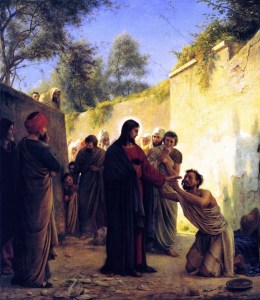
The blind man sat by the side of the road leading to Jericho, as he did every day, begging for money or food. But on this day, he heard the sounds of a crowd approaching. Judging by the excitement in the voices of the crowd, the blind man called out to those nearby, “What’s going on? What is all the excitement about?” Someone in the crowd replied, “It’s Jesus! Jesus of Nazareth is passing by!”

The blind man had heard about this Jesus of Nazareth. People had been saying that Jesus was the Messiah, the Son of David. So, the blind man began to cry out in a loud voice, “Jesus, Son of David, have mercy on me!” No doubt the people who lived in that area had heard this man crying out for mercy for a blind man as he begged for money or food. So, those nearest the blind man yelled, “Be quiet!” But the blind man would not be deterred. He needed to get Jesus’ attention. So the blind man started crying out even more loudly, “Son of David, have mercy on me!”

Jesus heard the man’s cry. He stopped walking and ordered that the man be brought to Him. When the blind man was brought before Him, Jesus asked, “What do you want me to do for you?” The man could have asked for money. He could have asked for food. But he had a bigger request, a God-sized request, and so he said to Jesus, “Lord, I want to see!” Although physically blind, the man had enough vision, enough faith to know that this Jesus, the Son of David, could give him what he wanted. Anyone could give him money or food, but Jesus was not just anyone. And so, the blind man’s faith led him to make a God-sized request, to ask for sight. And his faith was rewarded, as Jesus restored his sight. (Luke 18:35-43)

God wants us to come to Him with our requests, with our needs. He wants us to bring Him all of our requests, but He especially wants us to bring our God-sized requests to Him, those things that we can’t possibly do on our own. He wants us to have God-sized dreams and God-sized visions. When the blind man received His sight, He began to follow Jesus and began to glorify God. And those who saw what had happened gave praise to God. We need to be just like the blind man. We need to bring our God-sized requests, dreams, and visions to Jesus. Why? Because when those God-sized dreams and visions are fulfilled in our lives, they point us and those around us to God, and God will be glorified.


God Has No Favorites

no-favorites

What does it mean to be partial, to show partiality to someone or something? Partiality is defined as an unfair bias, favoring one person or one thing over another. When it comes to having a favorite food, such as being partial to apples over oranges, or having a favorite color, like preferring blue over green, partiality is not a bad thing. It’s actually pretty benign. But when it comes to preferring one person over another, such as showing favoritism or special privilege to a rich person while ignoring a poor person, partiality is something to be avoided. It is this type of partiality that the apostle James addresses in his letter. James 2:1-4 (NLT) says:

My dear brothers and sisters, how can you claim to have faith in our glorious Lord Jesus Christ if you favor some people over others? For example, suppose someone comes into your meeting dressed in fancy clothes and expensive jewelry, and another comes in who is poor and dressed in dirty clothes. If you give special attention and a good seat to the rich person, but you say to the poor one, “You can stand over there, or else sit on the floor”—well, doesn’t this discrimination show that your judgments are guided by evil motives?

James is addressing the early church here, advising them that they must not show partiality in their interactions with people. But the message is as pertinent to each of us now as it was to the early church. As James points out, if we show favoritism to one type of person over another, not only is our faith in question but our motives, as well. In fact, when we show partiality, we are actually committing sin and are breaking the law (James 2:9). What law is that? The law found in Leviticus 19:18, the law that Jesus Himself reiterated in Matthew 22:39: we must love our neighbor as ourselves!

Confucius once said, “The sun and the moon shine on all without partiality.” Each and every one of us receives the benefits of both of these two great lights that God created (Genesis 1:15-16). They are not partial to any of us. And neither is the God who created them. Romans 2:11 tells us that, when it comes to God, there is no partiality. In the NLT, this verse says, “For God does not show favoritism.” This is true when it comes to sin. Whether Jew or Gentile, God looks at those who do evil the same way, and they will be judged in the same way (Romans 2:9; 12). This same lack of partiality on God’s part also applies to God’s gracious gift of salvation.

Romans 3:23 points out that all of us have sinned. All of us fall way short of God’s glory. Not some of us, not a few of us. ALL of us. But God, through His infinite mercy and grace, has made a way for all of us to be right in His sight. He did this by the sacrifice of His Son, Jesus Christ, in order to pay the penalty for our sins (Romans 3:24). And all that we must do is place our faith in Jesus Christ. When we believe in Jesus, turn from our sins, and accept Him as Savior, we are made right with God. That applies not just to some of us, not just to a few of us, but to all of us. This promise of God is true for everyone who believes, no matter who we are (Romans 3:22).

God has no favorites. And neither should we.

Scripture quotations marked NLT are taken from the Holy Bible, New Living Translation, copyright © 1996, 2004, 2015 by Tyndale House Foundation. Used by permission of Tyndale House Publishers, Inc., Carol Stream, Illinois 60188. All rights reserved.

God is at Work

god at work

Electricity powers many things. It comes into our homes quietly and is always there when we need it (except, of course, during a power outage!). We can’t see it or feel it, but we know it’s working, even if we don’t turn on the lights in our homes. We know that all it takes is the flip of a switch and the lights are on. That’s a comforting thought. Just like the electricity in our homes, God is always working in our lives. We may not see Him working and we may not feel Him working, but He is always there at work in our lives, day in and day out. And, unlike electricity, God is not limited by power outages. And yet, sometimes we have more confidence in the electricity working in our homes than we have in God working in our lives.

When we are going through difficult times, He is working. When we are waiting for something to happen in our lives, He is working. When we are experiencing doubts that are threatening our faith, He is working. God was working in our lives before these times began, He is working through those times, and He will continue to work in our lives even when those times have passed.

When the Israelites were in bondage in Egypt, even when the Israelites did not see it or feel it, God was at work. He was setting the stage for a deliverer named Moses to be born. And when Moses became a man, God was busy preparing Moses, molding him into the leader that was needed to lead the Israelites out of their bondage. The Israelites may have felt that God had forgotten them, that He was not doing anything to answer their cries for help. But, as God commissioned Moses to do the work that He had prepared for him to do, God told Moses that He was fully aware of the sufferings of the Israelites (Exodus 3:7). God had heard their cries and seen their afflictions, and He was busy putting into place the plan for freeing them from their captors. God was at work.

Scripture assures us that God has a plan for our lives (Jeremiah 29:11). It is a plan for good and not for disaster. It is a plan that is designed to give us a future and a hope. We need to remember that promise at times when we doubt that God is working in our lives. In fact, it pleases Him to be at work in our lives (Philippians 2:13). In John 5:17, Jesus tells us that God is always working, and so is He. Jesus is the way and the truth and the life, and, if Jesus tells us that God is always working, that is something we can be confident of. At those times when we can’t see it or feel it, we need to be patient and believe that God is at work!

Hiding Behind a Facade

the-wonderful-wizard-of-oz-l-frank-baum-first-edition-1900

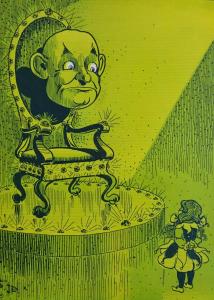
In The Wonderful Wizard of Oz by L. Frank Baum, the Wizard of Oz first appeared to the young girl named Dorothy as a great floating Head. He appeared to the Scarecrow as a lovely Lady, to the Tin Woodman as a terrible Beast, and to the Lion as a Ball of Fire. But, when the Wizard tried to delay the promises he made to these four, the Lion tried to frighten the Wizard by letting out a large roar. As he did, Dorothy’s dog, Toto, jumped back and knocked over a screen that stood in the corner, revealing a little old man with a bald head and wrinkled face. When asked by the Tin Woodman who he was, the little old man trembled as he replied, “I am Oz, the Great and Terrible.” But, as it turned out, this great and terrible wizard was not a wizard at all. He was simply a common man. He had landed the Emerald City many years before in a hot-air balloon, and the people of that city thought he was a great wizard, so this common man hid behind the facade of a great and terrible wizard.

Much like the Wizard of Oz, believers sometimes hide behind a facade. On the outside, we may appear to everyone as full of confidence and full of joy, while on the inside we may be filled with doubts, fears, and pain. We don’t want others to see that we are dealing with these things, and we are afraid to let others in. Often, this is because we believe that, as followers of Christ, saved by grace, we should not have feelings such as doubt, fear, and pain. But Jesus said that in this world we will have trouble, we will have trials and sorrows (John 16:33). The trouble Jesus spoke of includes such things as doubts, fears, and pain. So, it is inevitable that, at times in our lives, we will experience feelings such as these. But we must not hide behind a facade, not allowing others to see that we are not as together as we appear at the moment. So, what should we do?

First and foremost, we must cast our troubles on the Lord. Psalm 55:22 says that when we do this, He will sustain us. Jesus said that when we are weary and weighed down with troubles, we should come to Him (Matthew 11:28). He is there to help us shoulder our burdens, to help us through our times of trial, to help us deal with our feelings of doubt, fear, and pain. God has also placed others in our lives, people who can come alongside us and help us in dealing with what we are going through. But this can’t happen when we hide behind a facade, pretending that all is well when, in fact, it is not. All of us go through difficulties at times. God comforts us in those times so that we can comfort others (2 Corinthians 1:4). He helps us so that we can help others. So, when we are the ones going through a difficult time, we need to let others in to come alongside us. That person we let in may be the very person whom God has helped in the past so that he or she can help us now.