
The FDIC of God

In the 1930’s, the world experienced a severe economic crisis called the Great Depression. During this financial crisis, the U.S. government established the Federal Deposit Insurance Corporation (FDIC) in an effort to restore trust in the American banking system. Before the FDIC came into being, more than one-third of banks failed over the years and it was not uncommon for there to be runs on the banks. In these runs, large numbers of people would withdraw their money from the bank in fear that the bank would become insolvent and they would lose their money. The role of the FDIC was to insure all bank deposits. As a result, people felt more secure and the number of banks that failed dropped to near zero.
God has given us a treasure that is worth more than all of the money in the world. That treasure is the good news of salvation that comes to us through Jesus Christ. The apostle Paul was well aware of the value of that good news. He entrusted Timothy with it, so that he could also give it to others. In his first letter to Timothy, Paul urges Timothy to guard the deposit that has been entrusted to him. Paul wanted to be sure that Timothy held on to what he had deposited in him and did not let it become diluted by the empty doctrine of false teachers (1 Timothy 6:20-21). Paul knew that the pure, undiluted message of salvation that he entrusted to Timothy was the only way to insure the salvation of those who heard the message.
In his second letter to Timothy, Paul once again urged Timothy to guard the good deposit that had been entrusted to him (2 Timothy 1:14). The Greek word translated as guard here is phylassō, which means “to protect from loss or damage.” Timothy needed to protect believers from the doctrine being taught by false teachers and so he needed to protect the good news of Jesus Christ from being lost or damaged in any way. But Paul knew that Timothy could not do it alone. He needed someone to back him up and that someone was the Holy Spirit. So, Paul’s instruction to Timothy was to guard the good news by relying on the Holy Spirit who dwelt within him.

As believers, we are also entrusted with the good deposit of God’s good news of salvation. When we accept Christ as Lord and Savior and bring Him into our lives, like Timothy, we also have the Holy Spirit dwelling in us. We must guard the good news so that it can be given to others. Just as the FDIC insures all bank deposits, protecting the people from losing their money, so the Holy Spirit will insure the deposit of the good news that we have been given. Because we can rely on the Holy Spirit to help us as we guard our valuable deposit, we can continue to share that good news with others just as Christ commanded us to (Mark 16:15). 

Think on These Things

In the computer world, there is a saying that goes, “Garbage in, garbage out.” The quality of the output that you get from a computer is in direct proportion to the quality of what you put into it. If you give the computer a set of nonsensical instructions, the resulting output will be nonsense. If your input is of a high quality, the output will also be high quality.

The same holds true for our hearts and minds. What we put into our hearts and fill our minds with will affect what flows from our hearts and minds. When we put “garbage” in, “garbage” comes out. We are living in an era in which we are bombarded with information. The internet, cell phones, computers and tablets, and, of course, television, all give us access to more information than ever before. While some of that information is good and even beneficial, there is also a lot of “garbage.”

Scripture says that from the abundance of a man’s heart his mouth speaks (Luke 6:45). If a man’s heart is filled with that which is good, then his mouth will speak good. His life will reflect the good that has been put in his heart and mind. Conversely, if a man’s heart is filled with things that are evil or immoral, things that are not good, then his mouth will speak evil. His life will reflect the evil that has been put into his heart and mind.

As children of God and followers of Christ, it is important that we fill our hearts and minds with things that will cause our lives to reflect God’s goodness. God’s Word has provided us with the solution to ensuring that what flows from our hearts and our lives does just that. In Philippians 4:8, Paul lists the kinds of things that we should think about, that we should focus our hearts and minds on – things that are true, noble, right, pure, lovely, and admirable. He then sums up these things, and all others like them, into two categories, anything that is excellent and praiseworthy.

When we fill our hearts and minds with things that are both excellent and praiseworthy, then what flows from our hearts and minds will also be excellent and praiseworthy. This is what God desires for us and it is what we should always strive for. Paul knew that these things were important to believers. His life and his words demonstrated his belief in our need to carefully monitor what we put into our hearts and minds. In Philippians 4:9, he tells us that, if we follow his example and “practice these things,” then the peace of God will be with us.

Elements of True Worship

True worship is sincere and wholehearted. It is offered with humility and should be offered not just with our mouths, but also with our lives. True worshipers worship God in spirit and in truth. So, what does true worship look like? What are the elements of worship offered from the heart of a true worshiper? It should include praise offered through singing and music. We should come before the presence of the Lord with singing (Psalm 100:2). We should praise Him with trumpets, lutes, harps, and tambourines (Psalm 150:3-4). Our worship should include praise offered through dance (Psalm 150:4). King David, who is one of the greatest examples of a true worshiper, danced before the Lord when the ark of the covenant was brought to Jerusalem (2 Samuel 6:14).

True worship should be done with awe, or fear of the Lord. Fear of the Lord is the beginning of wisdom (Proverbs 1:7). To fear the Lord means having a sense of awe and respect for Him and for His power. We should worship God because we are in awe of Him. In addition to walking in His ways and loving and serving Him with all our heart and mind, God requires that we fear Him (Deuteronomy 10:12). That fear of the Lord, that awe and respect, should be evident in the heart of a true worshiper.

True worship should include trust and thanksgiving. Psalm 4:5 tells us that we offer right sacrifices (our worship is our sacrifice when we worship with our lives) and put our trust in the Lord. Without faith, without trust, it is impossible for us to draw near to Him (Hebrews 11:6). God is faithful and, in order to draw near to Him and worship Him, we must put our trust in Him. And, when we draw near to Him, when we enter His presence to worship Him, our hearts should be filled with thanks (Psalm 100:4). Trust in the Lord and a heart filled with gratitude should be the mark of a true worshiper.

True worship should be done with joy. Because of His great love, we have been freed from sin and its penalty and can stand in His presence. He is the rock of our salvation and when we sing our praises to Him, it should be a joyful noise (Psalm 95:1). The Lord has given us victory over sin and over our enemy and, for that, we should offer shouts of joy (Psalm 27:6). When Jesus ascended into heaven, His disciples worshiped Him and returned to Jerusalem with great joy. Their joy in the Lord was so great that they were continually found in the temple blessing and praising God. The joy of a true worshiper should be evident in the way in which he lives his life and offers his praise.

What is True Worship?

True worship, the kind of worship that God deserves and desires, can bring guidance, deliverance, and a greater sense of God’s presence to those who offer it. But what exactly is true worship? To determine what true worship is, we can begin by looking at what would be false worship. False worship is that which is unworthy of God or unacceptable to Him. It is worship that lacks sincerity, humility, and cost.

When our worship is insincere, we are just going through the motions. We may be singing praise to God but, because our hearts are far from Him, the words that come out of our mouths are nothing more than lip service (Isaiah 29:13; Matthew 15:8). We are worshiping simply because it is expected of us. It’s what we’re supposed to do. But, it is worship that is in vain. It is neither hot nor cold. It is lukewarm. Just as works done with a heart that is lukewarm, so lukewarm or insincere worship will make the Lord want to spit us out of His mouth (Revelation 4:15-16). Insincere worship is not true worship.
When we worship without humility, we are worshiping to make ourselves look good. We are looking to impress those around us. When we worship in this way, our worship lacks the reverence it requires. Our worship should be vertical and not horizontal. It must be directed to God and not to those around us. In Matthew 6:5, Jesus taught that, when we pray, we are not to be like hypocrites who do so in a manner to be seen by others. This holds true when it comes to worship, as well. Worship done to impress others is not true worship.
When we worship only through formal acts of worship, but not with our lives, our worship costs us nothing. Worship is not just singing our songs of praise and worship on Sunday. Worship must include living a life that conforms to God’s Word. Worship includes giving sacrificially of our time, talents, and treasure. God desires worship that involves our whole lives. He desires worship that is costly for us, worship that is marked by a life that does not conform to the world, by a life that is transformed by a renewal of the mind (Romans 12:1-2). It is worship that is a living sacrifice to God. Worship without cost is not true worship.
So, true worship is sincere. It requires all of our heart, not just part of it. True worship is done in humility, vertical worship done for God alone. And, true worship is costly. It involves offering our whole lives to God, not just a part of them. True worship is worship offered in spirit and in truth (John 4:23-24).

The Results of True Worship

We were created to worship God. Scripture commands that everything that has breath should praise the Lord (Psalm 150:6). We are to worship Him in spirit and in truth, for that is the kind of worship that God seeks (John 4:23). Our worship and our praise should be given with all of our heart, mind, soul, and strength. We are to worship God and praise Him with our mouths, but our worship should also be evident in the way in which we live.

We worship and praise God because He is worthy of it. Worship is not meant to be for us, but rather for God. It is not meant to make us happy or to make us feel good. But, when we offer God the worship that is due Him, there are benefits that come to us through His grace. True worship does bring benefits for the people of God.

True worship brings guidance. In Antioch, leaders of the church, along with Paul and Barnabas gathered to worship and fast as they sought guidance from the Lord. While they did so, the Holy Spirit spoke to them telling them that they were to set apart both Paul and Barnabas for the work to which the Lord was calling them. Following this instruction. the leaders laid hands on Paul and Barnabas and sent them off to spread the gospel (Acts 13:2-3). When we need guidance from the Lord in our lives, we should start by spending time in worship.

True worship brings deliverance. In Philippi, Paul and Silas were beaten and thrown into prison after Paul had driven a spirit of divination out of a slave girl whose owner profited by her ability to tell fortunes. While in that prison, Paul and Silas did not complain or wallow in self-pity. Instead, they lifted their voices in prayer and song, worshiping the Lord. As they did, a sudden earthquake shook the foundation of the prison, the prison doors were opened, and their shackles came loose. Seeing what had happened, the jailer and his family gave their hearts to the Lord. Not only were Paul and Silas delivered from their imprisonment, but the jailer and his family were also set free from the bondage of sin (Acts 16:25-35). When we need freedom in our lives, we can be sure that we will receive it when we worship the Lord.

True worship also brings a sense of God’s presence. When Solomon built the temple in Jerusalem, the priests brought the ark of the covenant to its place in that temple, the Most Holy Place. After the priests put the ark in the Most Holy Place, the musicians and singers began to offer praise to God, giving Him the worship He deserved. As they did, the temple was filled with a cloud. The glory of the presence of the Lord was so strong that the priests could not even stand to minister (2 Chronicles 5:13-14). When we offer God worship that comes from our hearts, when we worship Him in spirit and in truth, He will make His presence known to us. And, in His presence, their is fullness of joy.

Worship God because He is worthy. Praise the Lord and lift His holy name. When you offer true worship, it is pleasing to Him and, through His wonderful love and grace, you will be blessed.

Do Be a True Christian

Mr. Do Bee

I’m dating myself here but, when I was a kid, one of the shows I would often watch was Romper Room. Targeting children five years of age and younger, Romper Room taught many important lessons in how to be polite and well-mannered. In a day when prayer was not shunned in school and public settings, the children on the show even said grace (“God is great, God is good. Let us thank Him for our food. Amen.). Boy, have things changed!

Romper Room featured two oversized bumblebee characters, Mr. Do Bee and Mr. Don’t Bee, who taught children the right and wrong things to do, like “Do bee a sidewalk player, don’t bee a street player.” A Do Bee was someone who was cheerful and polite, while a Don’t Bee was grouchy. These were important lessons for children to learn.

In Romans, chapter 12, Paul gives us a list of things that we, as followers of Christ, should and should not do. They are things that are considered the marks of a good Christian. As Christians, the love we show to others should be sincere or genuine. We should not just pretend to love others, but truly love them. We should shun things that are evil, but cling to things that are good (Romans 9:9). We should not be lazy, but work hard, serving the Lord with enthusiasm (Romans 9:11). Rather than cursing those who persecute us, we should bless them, even praying that God will bless them (Romans 9:14).

We should live in harmony with others and never consider ourselves better than others (Romans 9:16). Evil should never be repaid with evil. Instead, we must look to do that which is good and honorable (Romans 9:17). When someone has hurt or wronged us, we should never seek vengeance, but pay them back with good. Vengeance should belong to the Lord and He alone will repay those who are evil (Romans 9:19). We should never let ourselves be overcome or conquered by evil, but we should overcome or conquer evil with good (Romans 9:21).

A true Christian is he who rejoices in hope, is patient through troubles, and is constant in prayer (Romans 9:12). He rejoices with those who rejoice and mourns with those who mourn (Romans 9:15). He loves his neighbor in the same way that he loves himself and, above all, he loves the Lord with his whole heart, soul, mind, and strength (Matthew 22:37-39). This is the type of Christian we all should strive to be.

Freedom!


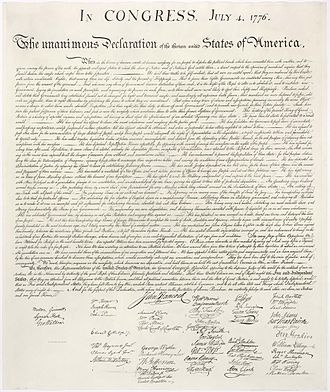
We hold these truths to be self-evident, that all men are created equal, that they are endowed by their Creator with certain unalienable Rights, that among these are Life, Liberty and the pursuit of Happiness.

– The Declaration of Independence, July 4, 1776

On July 4, 1776, the Continental Congress unanimously adopted the Declaration of Independence, declaring to the world the freedom of the American people from the rule of England. Our founding fathers believed that freedom was a right given to us by God. But that freedom came at a cost. Patrick Henry proclaimed, “Give me liberty or give me death.” He knew that freedom was worth dying for. Many Americans gave their lives in the American Revolution in order to secure that freedom. And many Americans have given their lives in wars since that time protecting that freedom.

The freedom that we, as Americans, enjoy today is precious and should never be taken for granted. It is a freedom that is available to all who call themselves Americans, citizens of the United States. But there is another type of freedom, one even more precious, that is available to everyone, no matter what nation they call their home. It is a freedom that we don’t deserve, but has been made available to us by the grace of God. And, just as our American freedom came at a cost, this freedom came at a cost, too.

This freedom is freedom from the bondage and penalty of sin. It is a freedom that we all need, as we are all sinners. It is a freedom that we can’t buy, it is a freedom that we can’t earn, but rather a freedom that comes to us freely from God through His Son, Jesus Christ. The cost of this freedom was paid through the blood of Jesus Christ, who died on a cross over two thousand years ago to pay the penalty for our sin and set us free from the bondage of that sin. All we need to do to secure this freedom is to believe in Jesus, believe that He died for us and that He rose from the grave.

Jesus said that, if we abide in His Word then, as His disciples, we will know the truth and that truth will set us free (John 8:31-32). Scripture tells us that it was for freedom that Jesus has set us free and we must never take that freedom for granted by submitting to the yoke of slavery that comes from sin (Galatians 5:1). We must live as a people who are free and not use our freedom as an excuse to continue doing evil (1 Peter 2:16). We must turn from our sin and follow Him and His ways. When we do, we become citizens of the kingdom of God, able to enjoy the freedom that God has provided for us.

O You of Little Faith!

In Capernaum, Jesus spent time at the home of Peter. First, he healed Peter’s mother-in-law, who was sick with fever, and then, that evening, many people who were either sick or oppressed by demons were brought to Him. Jesus cast out the demons with a word and healed all of those who were sick (Matthew 8:14-16). He then got into a boat to cross the Sea of Galilee and the disciples joined Him (Matthew 14:23).

No sooner did they set sail than a great storm arose. The winds blew, the rain fell, and the boat was tossed around on the waves. The waves were so bad that they swamped the boat. While all this was happening, Jesus lay sound asleep on a cushion in the stern of the boat. The disciples, on the other hand, were in a state of panic. They feared for their lives. They were going to perish while Jesus lay there sleeping. They shook Jesus awake. “Lord! Wake up! You have to save us or we’re done for!” (Matthew 8:24-25).

Jesus calmly got up from His sleep and took a look around Him at this fierce storm. He rebuked the winds and the waves and the storm instantly ceased. He then turned to His disciples and responded to their doubt that God would take care of them by giving them a little rebuking of their own. “What were you afraid of, o you of little faith?” (Matthew 8:26) These disciples had just seen Jesus heal many who were sick and drive out demons with just a word and yet, they did not have enough faith to know that because Jesus was with them, they did not have any reason to fear.

In direct contrast to the disciples’ lack of faith, just a day or so before this, Jesus had encountered the Roman centurion whose faith was so strong that he believed that Jesus did not need to come to his house to heal his servant. He had heard of the things that Jesus had done, and he believed that Jesus only needed to speak a word and the servant would be healed. As followers of Christ, when we are faced with storms in our lives, who are we more like? The doubting disciples or the believing centurion?

When facing storms in my own life, there have been times when I have been like the centurion. I knew I had Jesus in my life and I knew that He had brought me safely through the storms. But, I need to be completely honest here. There have also been many times when I have doubted. Despite the fact that I had seen Jesus’ hand in my life before, I hit the panic button just like the disciples did in that storm-tossed boat. But, the wonderful thing about out Lord and Savior is that, despite our doubt, He still calms our storms, just like He calmed that storm on the Sea of Galilee. It’s at those times that we need to say, “Lord, I believe. Help my unbelief!” (Mark 9:24)

A Tale of Two Men (A Story of Life and Death)

The Word of God speaks of two Adams. Through the first, sin entered the world, bringing with it death. And that sin, and the death in which it results, has been passed down to each and every one of us (Romans 5:12). Through this first Adam, we will all die but, through the second Adam, we all can be made alive (1 Corinthians 15:22). Through the second Adam, we have the ability to turn from that sin and the death in which it results by receiving God’s amazing grace and His gift of righteousness (Romans 5:17). The first Adam is man, whom God breathed life into, creating a living being. The second is Jesus Christ, the only begotten Son of God, who became not just flesh, but a life-giving Spirit (1 Corinthians 15:45).

We are all descendants of Adam, and we all have within us the sinful nature of man, the desires of the flesh. The wages of sin is death so, when we live by those desires, when we set our minds on the flesh, we are setting our minds on death. But, through Christ, we can put to death those sinful desires, choosing instead to allow the Spirit of God control our minds. When we do this, we are setting our minds on life and peace (Romans 8:6). When we invite Jesus into our lives, we allow the Spirit of God to dwell in us, we are no longer in the flesh (Romans 8:9). The flesh and its sinful nature no longer control us.

We have been given a choice. It is a choice between life and death. We can choose to live according to the flesh, giving into to its sinful nature and its desires that have no regard for God and for His commands. Or, we can choose to walk by the Spirit, seeking Him and responding to His guidance. The desires of the flesh and the desires of the Spirit run in direct opposition to each other. When we choose to walk in the Spirit, we will not gratify the desires of the flesh, as the Spirit will help us from doing the things that the flesh desires (Galatians 5:16-17).

The choice is ours. Life or death. Choose the ways of the flesh, its sinful nature and desires, and by doing so, choose death. Or, we can choose the ways of the Spirit by following Christ and allowing the Spirit of God to guide us and, by doing so, choose life.

Who is Jesus?

Who is Jesus? A great man? Absolutely! His compassion and love for those with whom He came in contact show that, not only was He a great man, but He was also the most compassionate and caring person known to man. A teacher? Most definitely! In fact, He was probably the greatest teacher that ever walked the face of this earth. The Son of God? Yes. He was sent by God, fulfilled all of the prophecies concerning the promised Messiah, and God Himself testified to who Jesus was when He said, “This is My beloved Son, with whom I am well pleased.” (Mark 1:11) But who and what else is Jesus?
Throughout the Gospel of John, Jesus used the phrase “I am” to describe Himself in seven different ways. He is the “bread of life,” the “light of the world,” the “door,” the “good shepherd,” the resurrection and the life,” the “way, and the truth, and the life,” and the “true vine.” In some cases, Jesus also connected who He said He is with some of the signs He performed.
“I am the bread of life.” In John 6, shortly after He fed 5,000 people with only five loaves of bread and two fish, Jesus said that He is the bread of life. In the Old Testament, God fed the Israelites by sending manna from heaven. But that was bread that provided sustenance for the day. A person could eat his fill and require more the next day. And, despite eating that bread, eventually a person would die. That bread provided sustenance, but when God sent Jesus into the world, He was sending bread that could provide eternal life. When we come to Jesus, when we believe in Him and follow Him as Lord and Savior, we will never go hungry and will have eternal life. (John 6:35-40).
“I am the light of the world.” Jesus is the Word of God and all things were created through Him. In Jesus, there was life and this life was the light of men which shines in the darkness (John 1:1-5). Because of sin, we all walk in spiritual darkness. In John 8:12, Jesus said that He is the light of the world. When we make the decision to follow Him, we no longer walk in darkness, but instead we walk in the light of life that comes from Jesus. He lights our paths and directs our steps with His glorious light (Psalm 119:105). Shortly after Jesus said that He is the light of the world, He came upon a man who was blind from birth, a man who had walked in physical darkness all his life. Jesus said that as long as He is in the world, He is the light of the world. He then proceeded to give the blind man sight, freeing him from his physical darkness, just as He frees us from our spiritual darkness (John 9:1-7).

“I am the resurrection and the life.” In John 11:25-26, Jesus said that He is the resurrection and the life. He promised that, if we believe in Him, we may die a physical death, but we will still live eternally in Him. Our bodies may fail, but our souls will never die, and one day, we will have a new, glorified body that will live forever. Jesus said that He is the resurrection and the life at the time that He was at the home of Martha and Mary, whose brother, Lazarus, had died four days earlier. Jesus wept for the loss of Lazarus, and for the grief of Martha and Mary, then performed one of His greatest miracles as He raised Lazarus back to life. Not only in words, but also in actions, Jesus proved that He is indeed the resurrection and the life.