Contrasts in Faith

Contrasts

The centurion was a man who knew the meaning of authority. As a leader in the army of Rome, he had soldiers under him who would go when he said, “Go!” and come when he said, “Come!” So, when the centurion sought out Jesus in Capernaum to ask Him to heal his servant who was sick, he was recognizing the authority that Jesus had. No doubt the centurion had heard reports of the things that Jesus had done and believed that Jesus had the authority to heal the servant just by speaking. When the centurion approached Jesus with this belief, Jesus was amazed at the faith of this Roman leader who was not even one of His own disciples. Jesus said that He had not seen such faith among any of His own people. The centurion’s faith was rewarded as Jesus spoke the word and healed the servant (Matthew 8:5-13).

That very same day, Jesus also healed Peter’s mother-in-law, who was lying in bed, sick with a fever. When Jesus touched her hand, the fever broke immediately, and she got up and began to serve Him (Matthew 8:14-15). That same day the disciples were witnesses to these and many other miracles that Jesus performed, casting out demons and healed all who were sick. If anyone should have recognized Jesus’ authority, it was His disciples. Yet, when they left Capernaum and got into a boat with Jesus, it soon became evident that their recognition of Jesus’ authority and their faith in Him were lacking.

As the boat sailed on the Sea of Galilee, a storm arose and the boat was swamped by the waves and tossed by the wind (Mark 4:35-37). While this was happening, Jesus was asleep in the stern of the boat. Now despite the fact that Jesus was with them, the same Jesus who healed Peter’s mother-in-law and the centurion’s servant, the same Jesus who had authority over sickness and authority over demons, the disciples panicked. They woke Jesus up and cried, “Teacher, don’t You care that we are about to die?” Jesus got up and spoke to the storm. The winds died down and the sea was once again calm. Jesus turned to the disciples and said, “Why are you all so afraid? Why do you have so little faith?” Seeing this, the disciples said to one another, “Who is this? Even the winds and the seas obey Him!” (Mark 4:38-41)

What a contrast in faith! A centurion who was not a follower saw in Jesus authority that no one else had. And yet, Jesus’ followers did not recognize that same authority.

May we all be like the centurion, having faith in Jesus and His authority over all things.

A House of Prayer

When Jesus cleared the temple of money-changers and those selling animals for sacrifices, He did so saying, “My Temple will be a house of prayer… (Luke 19:46, NLT). Jesus was quoting from the book of the prophet Isaiah, which says:

I will bring them to my holy mountain of Jerusalem
and will fill them with joy in my house of prayer.
I will accept their burnt offerings and sacrifices,
because my Temple will be called a house of prayer for all nations. (Isaiah 56:7, NLT)

Scripture shows us that it is God’s desire for the church to be a house of prayer, a place where people gather to pray together, a place where everything that is done is done in prayer and through prayer.

When you look at the accounts of the early church in the book of Acts, it is clear that prayer was at the center of the life of the gathered disciples of Christ. Acts 1:14 (ESV) says that the disciples were gathered together in unity and “were devoting themselves to prayer, together with the women and Mary the mother of Jesus, and His brothers.” In Acts, chapter 2, we see that “All the believers devoted themselves to the apostles’ teaching, and to fellowship, and to sharing in meals (including the Lord’s Supper), and to prayer (Acts 2:42, NLT).”

Prayer was a priority for the early church. Decisions such as the selection of leaders were accompanied by prayer. Acts 13:2-3 (ESV) says that as the believers were “worshiping the Lord and fasting, the Holy Spirit said, ‘Set apart for me Barnabas and Saul for the work to which I have called them.’ Then after fasting and praying they laid their hands on them and sent them off.” The believers prayed when fellow believers were persecuted. Acts 12:5 tells us that, while Peter was in prison, the church was lifting him up in earnest prayer.

The early church also prayed for healing. When a believer named Tabitha became ill and died, the people of Joppa heard that Peter was nearby. They brought him back to the home of Tabitha. Peter sent the people outside, then “knelt down and prayed.” After praying he turned to the body of the dead woman and said, “Tabitha, arise.” She opened her eyes and sat up. Peter’s prayer had been answered (Acts 9:36-40).

The leaders of the early church taught often on the subject of prayer. In Colossians 4:2, Paul wrote that believers should devote themselves to prayer with minds that are alert and hearts that are thankful. He asked the believers in Colosse to pray for the spread of the gospel (Colossians 4:3-4). James stressed the importance of prayers for those who are sick (James 5:14). Prayer was central to the ministry of the apostles. In Acts 6:2-4, they told the other believers to pick seven men to oversee the distribution of food among them so that the apostles, whose task was to teach the word of God, could spend their time in “prayer and teaching the word.”

A praying church is a healthy church, and God’s power will be evident in it. James 5:16 says that the earnest prayer of one righteous man has great power and is capable of producing wonderful results. Imagine the power and results that are possible when a church full of righteous men, women, and children make prayer a priority in their church!

Our Journey in Christ

long_road_to_nowhere

Once we become a follower of Christ, we begin a journey. It is a journey on the road to becoming more like Christ, and it is a journey that is full of ups and downs, highs and lows. Throughout the journey, we may stumble and fall. Throughout the journey, we may get stuck in ruts along the road or get sidelined by potholes that line the road. But, no matter how many times we fall, no matter how many times we get stuck, we need to brush ourselves off and get right back on the road. On this road, we will grow and mature as we are transformed into the image of Christ step by step, or as Paul says in 2 Corinthians 3:18, “from glory to glory.” That transformation comes through the help of the Spirit of the Lord. The key for us is not to give up, but to rely on the power of the Holy Spirit.

When we stumble and fall, which we will from time to time, we should look to the example of Peter. Throughout Scripture, we can see that Peter’s life was marked by many highs and lows. In Matthew 16, Peter declares that Jesus is the Messiah and is praised by Jesus for doing so (Matthew 16:16-17) but shortly after this, when Jesus tells His disciples that He will suffer and die, Peter pulls Jesus aside and reprimands Him for saying this. Jesus then rebukes Peter for speaking on behalf of Satan and setting his mind on the things of man rather than on the things of God (Matthew 16:21-23). Peter went from praise to rebuke in just eight verses!

When Jesus walked on water, Peter was the only one of Jesus’ disciples willing to step out of the boat they were in to walk in faith to Jesus. But then Peter took his eyes off Jesus and began to sink (Matthew 14:28-30). During the Last Supper, Peter boldly declared that he would never leave Jesus’ side, even if all of the other disciples did (Matthew 26:31-33). Yet, that very same night, Peter denied even knowing Jesus (Matthew 26:69-75). Clearly, Peter’s walk with Jesus was filled with highs and lows. But, despite his struggles, this same follower of Christ, empowered by the Holy Spirit, later had the power to speak to thousands of people after Pentecost, resulting in a harvest of new believers. And this same follower of Christ has been traditionally looked at as the first head of the church on earth.

When we are facing the lows or the ruts in our walk with Christ, we should think of Peter and be encouraged. No matter how many times we fail, no matter how many times we fall, the Holy Spirit will be there to help us. We simply need to seek His guidance, get back on track, and continue as we journey to becoming more and more like Christ.

I’m Free!

U.S. POSTAL SERVICE EMANCIPATION PROCLAMATION

In an effort to cripple the Confederacy, U.S. President Abraham Lincoln issued an executive order on September 22, 1862, proclaiming that the legal status of the 3 million slaves in the rebellious states would be changed from slave to free if the Confederate states did not cease their rebellion by January 1, 1863. The Confederacy did not yield and so, on January 1, 1863, Lincoln issued the Emancipation Proclamation. While the proclamation did not put an immediate end to slavery, it paved the way for the total abolition of slavery in the United States. On December 6, 1865, the 13th Amendment of the Constitution of the United States was passed, an amendment which abolished slavery.

In Luke’s Gospel, Jesus was at the synagogue in Nazareth and, as was His custom, He stood up to read from Scripture. He was handed the scroll of Isaiah, unrolled it and began to read (Luke 4:16-17). The words that Jesus read were His “Emancipation Proclamation.”

The Spirit of the LORD is upon me,
for he has anointed me to bring Good News to the poor.
He has sent me to proclaim that captives will be released,
that the blind will see,
that the oppressed will be set free,
and that the time of the LORD’s favor has come. (Luke 4:18-19, NLT)

Jesus came to set the captives, those who are oppressed, free. But the freedom that Jesus brings is not a physical freedom; it is a spiritual freedom. In John 8, Jesus is speaking to the Jews who had believed Him and tells them that, if they abide in His word, they are true disciples. They will know the truth and that truth will set them free (John 8:31-32). The Jews responded by pointing out that they are children of Abraham and have never been anyone’s slave. They could not understand why Jesus was telling them that they would be set free (John 4:33).

The slavery that Jesus was referring to was not physical slavery. It was spiritual slavery. Jesus answered their question by saying, “I tell you the truth, everyone who sins is a slave of sin (John 8:34).” When we live according to the desires of the flesh, our sinful nature, we are slaves to sin. But, thanks to the grace of God which was shown through Jesus Christ, His Son, we are no longer slaves to sin. Because of Jesus’ death and resurrection, those who believe and follow Him, while turning from sin, are now set free from that sin. As Jesus said in John 8:36, “So if the Son sets you free, you are free indeed.”

Love Your Neighbor

122px-Tablets_of_the_Ten_Commandments_001

Jesus said that the greatest commandment is to love God with our hearts, souls, and minds (Matthew 22:37-38). He followed that by saying that there is a second commandment that is just as important, that we must love our neighbor as we love ourselves (Matthew 22:39). These two commandments sum up God’s Law and the Prophets (Matthew 22:40). If we truly love God, we will worship Him only and not put any idols before Him. We will not take His name in vain, and we will honor the Sabbath, keeping it holy (Exodus 20:1-11). And when we love our neighbor, we will not steal, murder, commit adultery, covet, or bear false witness against anyone (Exodus 20:12-17).

It may be easy to say that you love God and have followed that first great commandment. But, what about the second? Now, you may say, “I have loved my neighbor as I love myself. I haven’t stolen from anyone, I haven’t committed murder or adultery, I don’t covet what belongs to others, and I have never borne false witness against anyone. So, I have obeyed the second commandment, as well!” But is that all there is to obeying the second great commandment? A look at Scripture will tell you that there is more to it.

In the Sermon on the Mount, Jesus gave us the Golden Rule. He said that we should do to others whatever we would have them do to us. He said that this is the essence of what is taught in the Law and the Prophets (Matthew 7:12). So, it also can be said that if we do anything to others that we would not want them to do to us, then we are violating God’s Law, violating the second great commandment. In the letter of James, we can see three specific behaviors that, although they are not murder, adultery, theft, or covetousness, would still be in violation of God’s law: showing partiality, speaking against a brother or sister, and judging others.

James 2:8 says that if we really fulfill the Law of God’s kingdom by loving our neighbor as ourselves, then we are doing well. But the letter goes on to say that, if we show partiality, we commit a sin and are convicted by the Law (James 3:9). If we favor one person over another, we are not truly loving our neighbor. In chapter 4 of the letter of James, we are told that we must not speak evil against another and we must not judge another. To do so is to speak evil against God’s law and to judge God’s law (James 4:11). If we do so, if we speak evil against someone or judge someone, we are not truly showing love to that person and so we violate God’s Law. After all, who are we to judge our neighbor? We must always remember that there is only one lawgiver and there is only one judge, God Himself.

I Have Good News!

good news

“I have good news!” How many of us love to hear or say those words? They could come from a child telling his parents about a good report card. It could be a husband telling his wife that he just received a raise in salary, or a wife telling her husband that they are going to have a baby. It could be a doctor telling a patient that a biopsy came back negative. Whatever form it takes, good news is something we all love to hear and to share.

The best news ever shared was the good news, or the gospel, of Jesus Christ. Jesus told His disciples to go out into the world and preach the gospel to everyone (Mark 16:15). The Greek word for “gospel” is evangelion, a word that was originally used when describing the “good news” of a military victory that was being brought by a messenger to his commanding officer. Later, that same word came to mean simply a “good message.” But thanks to the writers of the New Testament, the word evangelion came to refer to the “Good News” of Jesus Christ.

What is that good news? It’s the news that Jesus Christ, the only Son of God, became flesh and came to earth to pay the price for our sins. It’s the news that, while we were still sinners, Christ died for us (Romans 5:8). It’s the news that, if we confess with our mouths and believe in our hearts that Jesus Christ is Lord and that God raised Him from the dead, we receive the gift of salvation (Romans 10:9). It’s the news that, when we receive it and believe it, we must pass on to others. Why? First, because we want to be obedient to Jesus’ command to preach the gospel to everyone, but also because, as Paul says in Colossians 1:28, “We want to present them to God, perfect in their relationship to Christ.”

Scripture quotations are taken from the Holy Bible, New Living Translation, copyright © 1996, 2004, 2015 by Tyndale House Foundation. Used by permission of Tyndale House Publishers, Inc., Carol Stream, Illinois 60188. All rights reserved.

Tyndale House Publishers. (2013). Holy Bible: New Living Translation. Carol Stream, IL: Tyndale House Publishers.

The Ransom Has Been Paid

ransom verse

On December 8, 1963, 19-year-old Frank Sinatra, Jr. was kidnapped at gunpoint from his room at Harrah’s Casino in Lake Tahoe, California. Two days later, after allowing Sinatra, Jr. to speak to his famous dad, the kidnappers demanded a ransom of $240,000 for the victim’s safe release. Despite receiving offers of help from Attorney General Robert Kennedy and organized crime leader Sam Giancana, Frank Sinatra sought the help of the FBI to secure the release of his son and apprehend the kidnappers. The ransom was paid, and Sinatra, Jr. was released. A few days later, all of the kidnappers had been located and arrested.

The fall of man in the Garden of Eden allowed us to be “kidnapped,” held captive by sin and death. A ransom needed to be paid, but it was a ransom that we could not pay ourselves. Nor could this ransom be paid by another man or woman, even one with great wealth (Psalm 49:7-9). The ransom, the cost of redeeming us or liberating us from the sin that held us captive, was too high to be paid by man. But we have a heavenly Father who not only was able to pay our ransom but who also was willing to do so, despite the high ransom.

The ransom, the cost of liberating us from sin, from the empty life of the flesh that has been passed down throughout the generations, was not a cost that could be paid with silver and gold. Those are things that lose their value. Our ransom needed to be paid through the sacrifice of the sinless, spotless Lamb of God. Our ransom was the blood of our Savior and Redeemer, Jesus Christ, God’s only Son (1 Peter 1:18-19). And not only was God willing to pay that ransom through Jesus, but he had also chosen Jesus to be our ransom long before the world began (1 Peter 1:20).

Jesus came not to be served, but to serve. He came to give His life as a ransom for many (Matthew 20:28). The ransom has been paid, and we have been set free from the captivity of our sin. We must put our hope in the gift of salvation that comes from Jesus Christ. He paid the ransom that we could not pay because of His great love, grace, and mercy. In turn, we must live our lives as obedient children of God, turning away from the sinful desires of the flesh. And we must strive to live holy lives, being holy and righteous in all that we do, just as our heavenly Father is holy (1 Peter 1:13-16).

God Provides a Way Through

Crossing_of_the_Red_Sea_001

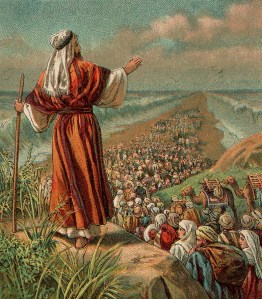
Then Moses raised his hand over the sea, and the LORD opened up a path through the water with a strong east wind. The wind blew all that night, turning the seabed into dry land. So the people of Israel walked through the middle of the sea on dry ground, with walls of water on each side! (Exodus 14:21–22, ESV)

The Israelites were free. Moses had led them out of Egypt, away from the bondage of slavery. But Pharaoh and his army were in pursuit, determined to capture the Israelites and bring them back to Egypt. While the Israelites were fleeing on foot, Pharaoh and his men were on horseback and gaining ground quickly. And, as the Egyptians overtook them, the people of Israel found themselves stuck between a rock and a hard place. Pharaoh and his men were behind them and in front of them was a seemingly insurmountable obstacle, the Red Sea. The people of Israel were faced with a situation from which they saw no way out.

In our lives, we may face situations from which we can see no way out, obstacles that seem insurmountable. They might be unexpected bills that we don’t have the funds to pay. Or they might be serious illnesses. They could be life-controlling addictions. When the people of Israel found themselves faced with the waters of the Red Sea and the possibility of being captured by Pharaoh and brought back into slavery, or worse yet, killed in the wilderness, they abandoned hope and panicked, saying that it would have been better for them to have remained as slaves in Egypt (Exodus 14:10-12). They saw no way out of the situation they were in.

But Moses had faith in God, who had gotten them this far. Moses knew that God would help them through this situation. Moses told the people to remain calm and wait on the Lord to pull them through. Then, with staff in hand as God had instructed, Moses raised his hand over the sea. As a result of this act of faith on the part of Moses, the waters of the Red Sea parted and the people of Israel passed through it on dry land (Exodus 14:21-22). When their pursuers followed them, God closed up the sea, and all of Pharaoh’s men were covered by the waters. God had provided the way through for His people (Exodus 14:26-28).

When we face difficult situations that seem impossible to overcome, we need to have faith like Moses, believing that God will provide a way through, just as He provided a way through the Red Sea for the people of Israel. In those situations, we must remember these words of Jesus, “Have faith in God. I tell you the truth, you can say to this mountain, ‘May you be lifted up and thrown into the sea,’ and it will happen. But you must really believe it will happen and have no doubt in your heart.” (Mark 11:22–23)

Scripture quotations are taken from the Holy Bible, New Living Translation, copyright © 1996, 2004, 2015 by Tyndale House Foundation. Used by permission of Tyndale House Publishers, Inc., Carol Stream, Illinois 60188. All rights reserved.

Tyndale House Publishers. (2013). Holy Bible: New Living Translation. Carol Stream, IL: Tyndale House Publishers.

“O death, where is your sting?”

honeybee-525224_960_720

If you’ve ever been stung by a bee, you know it can be quite painful. Most people have no reaction to a bee sting other than the pain, but for some people, that sting can cause major problems. Due to an allergy that these people have to the venom, that painful sting can cause illness and even lead to death. When that happens, you could say that the bee has had victory over the person it stung.

Sin can be just like a bee sting. It can be painful and lead to problems in our lives, problems that can manifest themselves in things like depression, broken relationships, physical illness, and even death. Sin is Satan’s victory over us, and that victory started in the Garden of Eden when Satan deceived Adam and Eve into disobeying God. That disobedience led to sin and death. Scripture tells us that sin is the sting of death (1 Corinthians 15:56). But because of God’s grace, mercy, and love for us, which were shown by Jesus’ sacrificial death on the cross, the sting of sin and death no longer has a hold on us.

When a honey bee stings someone, the bee’s barbed stinger gets caught in the person’s skin, and when the bee pulls away, the stinger and part of the bee’s abdomen break off, resulting in the death of the bee. So, you could say that the bee’s victory over that person is short-lived. This is true of Satan’s victory over us. Satan’s victory in the Garden and His seeming victory in the death of Jesus were short-lived. When Jesus rose from the grave, Satan’s victory, the victory of sin and death, was reversed. In 1 Corinthians 15:55, Paul wrote, “O death, where is your victory? O death, where is your sting?”

The victory no longer belongs to Satan, it no longer belongs to sin and death. The victory belongs to us! It was a victory that has been given to us through Jesus Christ. We can claim that victory over sin and death when we choose to turn from sin, to believe that Jesus died for us and was raised from the dead, to confess Him as Lord, and to follow Him all the days of our lives.

Faith Alignment

Anyone who owns a car knows that, occasionally, the tires can go out of alignment. Potholes are one of the biggest culprits in taking your tires out of alignment. After a snowy winter, roads may be full of potholes, and hitting these potholes can take tires that were once nicely aligned and throw tires that were once nicely aligned into misalignment. Misaligned tires can wear unevenly, causing you to need new tires, the car’s fuel efficiency can be diminished, increasing your gas costs, and the steering may pull in one direction, affecting the safe handling of the car. The solution to these problems is to have the tires realigned, restoring them back to the correct alignment.

In Luke 22:31, Jesus warned Simon Peter of this very thing. On the night before He died, Jesus said, “Simon, Simon, Satan has asked to sift each of you like wheat.” Jesus knew that when He was taken from them, Simon Peter and the other disciples would be scattered like sheep without a shepherd. Their alignment would be off, and their faith would be shaken. But Jesus also said that He had interceded in prayer for Simon Peter, praying that his faith would not fail so that when he had repented and turned back to Jesus, Simon Peter would be able to strengthen his brothers (Luke 22:32). When Simon Peter protested that he was ready to go to prison with Jesus and even die for Him, if necessary, Jesus predicted that Simon Peter would deny that he even knew Jesus three times that very night (Luke 22:33-34).

As Jesus predicted, Simon Peter did deny Jesus. Seeing Jesus arrested and brought to trial before the Sanhedrin shook Peter’s faith to the core. Satan threw a pothole at Peter that threw his faith out of alignment. As followers of Christ, we need to keep our hearts and our lives aligned with Him. But we have an enemy who, like a pothole, will try to throw our faith out of alignment. Our enemy will try to place doubts in our minds, shaking our faith when trials and tribulations come our way. And when our faith is shaken to its core we may deny Jesus, just as Simon Peter did. But the good news is that, when our faith is taken out of alignment, there is a way to have it realigned. That way was given by Jesus in Luke 22:32. We must repent and turn back to Jesus. When we do, not only will our faith be realigned, but we will also be able to strengthen the faith of our brothers and sisters who may be struggling.