

Pay It Forward

B-70-154-KINDNESS-MATTERS-PAY-IT-FORWARD

In 2000, a movie hit theaters about a young boy named Trevor McKinney who receives a challenging assignment from his social studies teacher. The assignment is to think of an idea that would change the world and then put that idea into action. Trevor comes up with the idea of repaying good deeds not by paying back the person who performed the good deed, but by paying forward with new good deeds done to three new people. The movie was Pay It Forward.

The concept of paying something forward is not a new idea. In 1784, Benjamin Franklin wrote in a letter to Benjamin Webb, “I do not pretend to give such a deed; I only lend it to you. When you […] meet with another honest Man in similar Distress, you must pay me by lending this Sum to him; enjoining him to discharge the Debt by a like operation, when he shall be able, and shall meet with another opportunity. I hope it may thus go thro’ many hands, before it meets with a Knave that will stop its Progress. This is a trick of mine for doing a deal of good with a little money.” In her 1916 book, In the Garden of Delight, Lily Hardy Hammond wrote, “You don’t pay love back; you pay it forward.” The definition of the term “pay it forward” is to respond to the kindness that someone shows to you by being kind to someone else.

Kindness is a fruit of the Spirit (Galatians 5:22). As such, it is something that a follower of Christ should look to cultivate in his or her life. Jesus said that, if we want to be His disciples, we must deny ourselves, take up our cross, and follow Him (Luke 9:23). He has set the example for us, and it should be our desire to be like Him. We need to have the same attitude toward each other that He had toward us (Philippians 2:5). Jesus placed our interests and the interests of God above His own, so we must place the interests of others above our own Philippians 2:4). He came to serve, so we must serve (John 13:14-16). He loves us, so we must love others (John 15:12). Jesus showed kindness, or compassion, to those He came in contact with, so we must show kindness to others.

Ephesians 4:32 (NET) tells us that we must “be kind to one another, compassionate, forgiving one another, just as God in Christ also forgave you.” The things that Jesus does for us, we must do for others. In other words, as followers of Christ, we must always look to “pay it forward.”

Be Kind to One Another

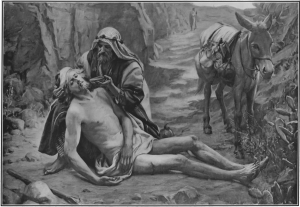
Good Samaritan

American author Henry James once said, “Three things in human life are important. The first is to be kind. The second is to be kind. And the third is to be kind.” Henry James apparently placed great importance on kindness. Kindness is shown in an attitude of care and concern for others, especially those who are weak, poor, or in need. A synonym for kindness is compassion. Compassion is shown by God to His people (Isaiah 63:7). And compassion is something that is seen in the character of Jesus Christ. This compassion is spoken of in the gospel accounts, in verses such as Matthew 9:36 (NIV), which says that when Jesus saw the crowds who gathered as He made His way through their towns and villages, “he had compassion on them, because they were harassed and helpless, like sheep without a shepherd.”

God’s Word makes it very clear that kindness, or compassion, is important in the life of a believer. It is counted as one of the fruit of the Spirit, which are characteristics that must take root in our lives (Galatians 5:22). In his letter to the believers in Ephesus, the apostle Paul wrote that we must be kind to one another, we must be compassionate and must forgive, just as God forgave us (Ephesians 4:32). Paul mentioned kindness again in Colossians 3:12, pointing out that in addition to such virtues as humility and patience, we must clothe ourselves with a heart of kindness. In 1 Peter 3:8, Peter exhorts us to be like-minded, sympathetic, and compassionate.

Kindness is something that believers must show to one another, but it doesn’t stop there. God wants us to be kind, or compassionate, to all. We should display kindness, or compassion, to the sick, to the needy, to those who mourn, to those who are alone, and to those who are oppressed. And we must display kindness, or compassion, to people we don’t like, and even to our enemies. We are commanded in Scripture to love our neighbor, and our neighbor includes anyone with whom we come in contact who is in need. Jesus illustrated this in the parable of the Good Samaritan. Although Samaritans and Jews despised each other, it was a Samaritan who, upon seeing a Jewish man who had been robbed and beaten lying on the side of the road, felt compassion and took care of the beaten man (Luke 10:30-35).

My prayer is that all believers will show the kindness, or compassion, of the Good Samaritan, the kindness, the compassion that comes from God, not just to each other but to all who need it.


Our Plans and God’s Will

Proverbs 27_1, GNT

In January 1957, the following quote by writer, journalist, and cartoonist Allen Saunders was published in Reader’s Digest magazine: “Life is what happens to you while you’re busy making other plans.” Those same words also appeared 23 years later in the lyrics of the 1980 song by John Lennon, “Beautiful Boy.” Another way of putting the sentiment of these words would be, “Go ahead and make your plans but live one day at a time because you don’t know what tomorrow will bring.” Proverbs 27:1 in the Good News Translation says, “Never boast about tomorrow. You don’t know what will happen between now and then.”

The truth is that we can make all of the plans we want to make, but we don’t know what will happen tomorrow. Life is uncertain. James 4:14 (NET) says, “You do not know about tomorrow. What is your life like? For you are a puff of smoke that appears for a short time and then vanishes.” Life is also as complex as a good mystery novel. It is made up of minutes, hours, and days that are filled with people, places, and things. And each day, we may be called upon to make decisions, some of which may be critical, and some which may be routine and even mundane. And while there is nothing wrong with making plans, and we should do so, we must never allow pride or arrogance to cause us to boast about our plans (James 4:16). When we make plans, they should be made saying, “This is what I will do, if it’s God’s will (James 4:15).”

When we do things in accordance with God’s will, when we place His will above our plans, then we are doing what Jesus taught in Matthew 6:33-34 (NET) when He said, “But above all pursue his kingdom and righteousness, and all these things will be given to you as well. So then, do not worry about tomorrow, for tomorrow will worry about itself. Today has enough trouble of its own.” Trusting in our own plans can lead to anxiety, but when we trust in God’s will for us, in His plan for us, and do so with all our hearts, then we can walk in confidence, knowing that He will guide us each step of the way (Proverbs 3:5-6). And we can face life with the certainty that God’s plans for us are never to harm us, but rather to prosper us (Jeremiah 29:11).

Living life based on our own plans brings uncertainty, but life in accordance with the will of God brings certainty, even when we don’t know what tomorrow will bring.

Scripture quotations marked GNT are taken from the Good News Translation — Second Edition. Copyright © 1992 by American Bible Society. Used by permission. All rights reserved.

Scripture quoted by permission. Quotations designated (NET) are from The NET Bible® Copyright © 2005 by Biblical Studies Press, L.L.C. www.bible.org All rights reserved.

Thoughts on Prayer

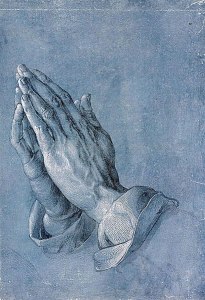
409px-Duerer-Prayer

For the Christian, prayer should be a regular part of our lives as it is through an attitude of prayerfulness that we develop our relationship with God. Martin Luther King, Jr. once said, “To be a Christian without prayer is no more possible than to be alive without breathing.” Think about it this way: in a marriage, you are in a committed relationship with someone, a relationship where one of the most important aspects is communication. In order for that marriage to work, to be alive, you need to communicate with your spouse. If communication is not there, the relationship breaks down and eventually dies. So it is in our relationship with God. We need to communicate with Him, and the way that we do that is through prayer. When we spend time in prayer, we are demonstrating our desire to be with God, as well as our trust in Him.

Prayer brings us into the presence of God. Because of Christ’s sacrifice for us, we have access to God, and we tap into that access through prayer. God desires to be in a relationship with us, and He is always there waiting to hear the voices of His children. He delights in hearing our voices, just as any of us who have children of our own desire to hear their voices. And children love to be in the presence of their parents, to talk to them, and listen to them. Being in the presence of mom or dad can be a source of joy for a child. When we spend time in God’s presence through prayer, we are saying to God, “Father, I want to be with You.”

When we pray, we are in the presence of our heavenly Father. And when we find ourselves in His presence, our hearts, and our entire beings will want to shout for joy (Psalm 84:1-2). Brother Lawrence was a lay brother in a Carmelite monastery in Paris in the 17th century, where his primary duties were cooking and washing dishes. This humble man of God knew the joy that comes from being in God’s presence at all times. In the book, The Practice of the Presence of God, we read that when the day’s appointed times of prayer were done, Brother Lawrence “continued with God, praising and blessing Him with all his might, so that he passed his life in continued joy.”

Prayer also demonstrates our trust in God. We are trusting that He will hear us. In Jeremiah 29:12, God tells us that when we call out to Him and come to Him in prayer, then He will hear our prayers. In John 11:41-42 (NET), Jesus demonstrated the confidence that we should have that God hears our prayers when, before raising Lazarus from the dead, He prayed, “Father, I thank you that you have listened to me. I knew that you always listen to me, but I said this for the sake of the crowd standing around here, that they may believe that you sent me.” When we place our needs before God through prayer, we are like the widow that Paul speaks of in 1 Timothy 5:5 (NET), the widow who is in need and on her own, but “has set her hope on God and continues in her pleas and prayers night and day.”

May we always remember to seek the presence of the Lord through time spent in prayer and to place our hope and our trust in Him. He hears our prayers and will answer in accordance with His will for us.

SPOILER ALERT: Jesus Wins!

Spoiler Alert

But thanks be to God, who gives us the victory through our Lord Jesus Christ! (1 Corinthians 15:57, NET)

In the 1989 motion picture, Back to the Future Part II, one of the characters, Biff Tannen, takes a sports almanac from the year 2000 and travels back in time from 2015 to 1955 and gives the almanac to his younger self. The almanac contains the results of numerous sporting events from 1950 to 2000. Armed with this almanac, the 1955 Biff goes on to become rich by betting on events that he already knows the winner of. By knowing who won, Biff is able to dramatically change his life.

SPOILER ALERT! The Bible has given us the results of earth’s final battle, a battle that will be fought at a place called Armageddon. Although we don’t know the day or the hour, we know that one day Jesus will return to earth. When that time comes, Satan, along with the Antichrist and the false prophet, will send demonic spirits into the world to deceive earthly rulers into joining them in battle against Jesus (Revelation 16:13-14, 16). The forces of evil will gather at Armageddon, the battle will be fought, and the armies of evil will be defeated. Satan will be bound and Jesus will be victorious (Revelation 19:19-20:3). A thousand years later, Satan will be let loose from his prison and will deceive the nations of the world. They will join together for battle, but fire from heaven will consume them and Satan himself will be cast into the lake of fire for eternity (Revelation 20:7-10). The winner is Jesus!

Just as Biff Tannen was able to change his life because of the words of that sports almanac, we too can change our lives through the words of the Bible, God’s Word. But the change that will take place will not be in the gaining of earthly riches. The change that will take place will be in our hearts. The Bible is the living Word of God, the story of God’s love for us that was demonstrated by the sacrifice of His Son, Jesus, to pay the penalty for our sins (John 3:16). When Jesus died for our sins, then rose from the grave three days later, He conquered sin and death. And when we believe in Him, turn from sin, and follow Him, we share in His victory (1 Corinthians 15:57). With Christ in us, we become a new creation, changed from within (2 Corinthians 5:17). We become part of the winning team. And that change brings with it the promise of eternal life with Christ, a treasure far greater than all the riches in the world.

Neither Rain nor Snow…

american-mailboxes

In ancient Persia, around 500 B.C., there was a system of mounted couriers called the angarium. Herodotus, a fifth century B.C. Greek historian wrote of these couriers in his work entitled The Histories, saying that they were “stayed neither by snow nor rain nor heat nor darkness from accomplishing their appointed course with all speed.” Does that sound familiar? The United States Postal Service (USPS) adapted those words to their creed, which reads:

“Neither snow nor rain nor heat nor gloom of night stays these couriers from the swift completion of their appointed rounds.”

This creed is meant to imply that there is absolutely nothing that will stop the Postal Service from delivering the mail. However, in 2015, a large snowstorm in the Northeast caused the USPS to cancel deliveries.

It would seem that the USPS cannot be considered 100% reliable. In fact, in this world there is probably nothing that we can say with complete certainty is 100% reliable – not people, not vehicles, nothing that comes from man. But there is something that we can totally depend on, something that we can say with complete certainty is 100% reliable. That something is the love of God.

God’s love is there for us through any and all of the trials we encounter. His love is there for us through our sickness, through our weakness, and through the times when we seem to be in the wilderness. His love is there even when we are not particularly lovable. God loves us through all these things. Psalm 118:1 (NLT) says, “Give thanks to the Lord, for He is good! His faithful love endures forever.” Because God is faithful, we can count on His love. That love that was fully revealed to us through His Son, Jesus Christ (John 3:16).

The USPS creed may not spark much confidence in us, but the following words of Romans 8:38-39 (NLT) are words that we can count on, words that are 100% reliable from a God who is the same today as He was yesterday and will be tomorrow (Hebrews 13:8).

And I am convinced that nothing can ever separate us from God’s love. Neither death nor life, neither angels nor demons, neither our fears for today nor our worries about tomorrow—not even the powers of hell can separate us from God’s love. No power in the sky above or in the earth below—indeed, nothing in all creation will ever be able to separate us from the love of God that is revealed in Christ Jesus our Lord.

Amen and amen!

Scripture quotations are taken from the Holy Bible, New Living Translation, copyright © 1996, 2004, 2015 by Tyndale House Foundation. Used by permission of Tyndale House Publishers, Inc., Carol Stream, Illinois 60188. All rights reserved.

It Smells Like Sunday

Welcome

As I stood outside of my church yesterday afternoon, a man and a young boy of perhaps 9 or 10 years old walked out of the building. As they passed, I heard the young boy say, “It smells like Sunday.” The boy’s statement brought a smile to my face as I began to think, “What does Sunday smell like?” For some, the smell of Sunday could be the fragrance of Dad’s cologne as he gets ready for church. For some, it could be the aroma of bacon, eggs, toast, and freshly brewed coffee coming from the kitchen as Mom prepares Sunday breakfast. For some, it could be the odor of fresh ink on newsprint as they read the Sunday paper. And for others, it could be the fragrance of incense as they walk into church on Sunday morning.

These earthly smells, these aromas, are pleasing to many, but there are other smells, spiritual aromas, that are even more pleasing, especially to God. On Sunday mornings, churches are filled with followers of Christ who gather together to lift their voices in praise to God and to hear the Word of God. Heartfelt praise lifted up to God is like incense; it is a fragrant offering, an aroma that is pleasing to God. Our praise is like the burnt offerings, the grain offerings, and the drink offerings offered to God by the people of Israel. It is a pleasing aroma, a sweet aroma, a sacrifice lifted up to God (Numbers 18:6, 29:6).

When the gospel of Jesus Christ is shared with those who have not heard it, the knowledge of Christ and His sacrifice for us is a fragrance that is spread throughout the world by those who have already heard and accepted it. Followers of Christ are the sweet aroma of Christ among those people who are being saved, a fragrance that can bring life to those who come to accept the gospel when it is delivered to them (2 Corinthians 2:14-16). When we give our lives to Christ and others learn about Him through our words and actions, our lives become a sacrifice that is pleasing to God (Romans 12:1). Our lives become a sweet aroma to Him.

The smell of Sunday, the sweet aroma that is pleasing to God, should not be limited to Sunday mornings. We should look to be that sweet aroma to Him every day of the week.

Grace in Time of Need

800px-Gottvater_thronend_Westfalen_15_Jh

Where can we turn when we need help, when we find ourselves in a time of need? We can find the answer to this in the letter to the Hebrews:

Therefore let us confidently approach the throne of grace to receive mercy and find grace whenever we need help. (Hebrews 4:16, NET)

That same verse in the Good News Translation (GNT) reads:

Let us have confidence, then, and approach God’s throne, where there is grace. There we will receive mercy and find grace to help us just when we need it.

What a wonderful promise! There is grace at the throne of God and, when we approach His throne of grace, we can be assured that His mercy and grace will be given to us to help us through whatever it is we are going through. We don’t have to approach the throne timidly or hesitantly. We can approach God’s throne confidently! How do we know that? In this verse, there is a word that points us to the answer to that question. In the NET, as well as other translations, that word is “therefore,” a word which means “for that reason” or “because of that.” That word is pointing us to the two verses which precede Hebrews 4:16:

Therefore since we have a great high priest who has passed through the heavens, Jesus the Son of God, let us hold fast to our confession. For we do not have a high priest incapable of sympathizing with our weaknesses, but one who has been tempted in every way just as we are, yet without sin. (Hebrews 4:14–15, NET)

We can approach God’s throne of grace with confidence because, in Jesus, we have a great high priest. He is not a high priest that cannot empathize with what we are going through. Rather, He is a high priest who fully understands our human weaknesses. He is a high priest who has been tempted just as we are but is without sin. Jesus’ faithfulness, shown through His death on the cross, has provided us access to the throne of God, and it is His faithfulness that allows us to approach God with confidence and boldness (Ephesians 3:12).

When we confess Jesus as Lord of our lives, His sacrifice for us provides access to the throne, and His ability to understand our weaknesses, our pain, and our hurts enables us to approach the throne with confidence.

Scripture quoted by permission. Quotations designated (NET) are from The NET Bible® Copyright © 2005 by Biblical Studies Press, L.L.C. www.bible.org All rights reserved.

Scripture quotations marked GNT are taken from the Good News Translation — Second Edition. Copyright © 1992 by American Bible Society. Used by permission. All rights reserved.

Then I Will Heal Their Land

grunge-american-flag-14286711971wT

In 1952, U.S. President Harry S. Truman signed a bill that proclaimed the President of the United States must declare a National Day of Prayer each year to be held in May, on a day other than Sunday. That bill (36 U.S. Code § 119) was revised in 1998, designating the first Thursday of May as a National Day of Prayer:

The President shall issue each year a proclamation designating the first Thursday in May as a National Day of Prayer on which the people of the United States may turn to God in prayer and meditation at churches, in groups, and as individuals.

Each year since the bill was passed, the President has signed a proclamation encouraging all Americans to pray on that day.

While there have been many times throughout our nation’s history that prayer and a reliance on God have been needed, we are perhaps in a time when that prayer is more sorely needed than ever before. This nation has turned its back on God. Prayer and the Bible are not allowed in schools. Millions of innocent lives are lost each day to abortion. Recently, a comedian joked about abortion at a White House correspondents dinner, eliciting laughter from some of those in attendance. Our sense of morality has greatly declined. When our country was attacked on 9/11/2001, many turned to God to seek His help and comfort. Church attendance increased but, as the distance of time pushed the memory of 9/11 into the past, that attendance went back to normal and is now in a state of decline.

After Solomon built the Temple in Jerusalem, God appeared to Solomon at night and told him that He had chosen the Temple to be the place where sacrifices would be made, the place where His presence would dwell. God told Solomon that if His judgment should ever fall on the nation of Israel, all they would need to do would be to turn to Him in prayer with humility and repentance; they would receive His forgiveness, and their land would be healed (2 Chronicles 7:11-14). In the New Jerusalem Bible, verse 14 reads:

“if my people who bear my name humble themselves, and pray and seek my presence and turn from their wicked ways, then I will listen from heaven and forgive their sins and restore their country.”

America needs God. It needs to be restored by God. It needs revival, and the church must be at the forefront. There is a greater need than ever for the people of God to lift up their voices as they cry out to Him in prayer for our country. When Jesus paid the price for our sins by His sacrificial death on the cross, the curtain of the Temple was torn in two. No longer was the Temple the place where God’s presence would dwell. He now dwells in the hearts of believers (1 Corinthians 3:16). In 2 Chronicles 7:15 (NET), regarding the Temple, God told Solomon that He would “be attentive and responsive to the prayers offered in this place.” Since the Temple of God is now in the hearts of believers, we can be sure that He will be attentive and will respond to the prayers we lift up on behalf of our nation.

Scripture quotations marked NJB are from The New Jerusalem Bible, copyright © 1985 by Darton, Longman & Todd, Ltd. and Doubleday, a division of Random House, Inc.  Reprinted by Permission.

Scripture quoted by permission. Quotations designated (NET) are from The NET Bible® Copyright © 2005 by Biblical Studies Press, L.L.C. www.bible.org All rights reserved.

Choose Your Friends Wisely

choose wisely

“Choose your friends wisely.”

Has anyone ever said that to you? Perhaps a parent, a grandparent, or maybe a teacher or pastor? There is a lot of truth to that statement. It is important that, as we go through life, we make wise choices in the area of friends. The friends we choose can say a lot about our own character. We want to choose friends who share our values, friends who will build us up and will not bring us down. True friends, the kind of friends that it is wise to choose, are the type of friends spoken of by the writer of Proverbs 27:17, who wrote, “As iron sharpens iron, so a person sharpens his friend.” Solomon wrote that a friend loves at all times (Proverbs 17:17) and said that there is a friend who will stick closer to you than a brother (Proverbs 18:24). Friendship, true friendship, is important, and so is our choice of friends.

In John 15:13, Jesus said, “No one has greater love than this—that one lays down his life for his friends.” That is the truest test of friendship. The best friend we could have is one who is willing to lay down his life for us. So, when it comes to choosing friends, the best friend that we could possibly have is Jesus. He is a friend who loves at all times. Jesus is a friend who sticks closer to us than a brother. Jesus is a friend who will always build us up and never bring us down. And Jesus is also a friend who not only was willing to lay down His life for us, but actually did so. When we do as Jesus commands, when we turn from our sin and follow in His ways, we can count Jesus as a friend (John 15:14-15). So, if we are truly wise in choosing our friends, we will choose friendship with Jesus and with those who are committed to following Him, and we will steer clear of those who follow the ways of the world, seeking the desires of the flesh.

When we choose to remain in sin, to walk in the ways of the world rather than in the ways of Jesus, we are choosing friendship with the world. And when we choose friendship with the world, following the desires of the flesh, our sin makes us enemies of God. James 4:4 says, “do you not know that friendship with the world means hostility toward God? So whoever decides to be the world’s friend makes himself God’s enemy.” But thankfully, God gives to the humble grace that is greater than sin (James 4:6). When we humble ourselves before Him, when we submit to Him and resist sin and the devil, the devil will flee (James 4:7). We are then able to draw near to God and He will draw near to us (James 4:8). Our friendship is restored.

Choose your friends wisely. Do not choose friendship with the world and its wicked ways. Choose friendship with God through Jesus Christ, the friend who laid down His life for all of us. Choose friendship with those who seek to follow Jesus and will help you to do the same.

Scripture quoted by permission. Quotations designated (NET) are from The NET Bible®
Copyright © 2005 by Biblical Studies Press, L.L.C. www.netbible.com
All rights reserved

Biblical Studies Press. (2005). The NET Bible First Edition; Bible. English. NET Bible.; The NET Bible. Biblical Studies Press.