
Don’t Hold Your Breath, Breathe Out Forgiveness

Peter had a question for Jesus, one he was sure he already knew the answer to. So he went to Jesus and asked, “Lord, how many times should I forgive someone who sins against me?” But before Jesus could answer, Peter attempted to answer his own question by asking, “Seven times?” Imagine Peter’s surprise (and perhaps his disappointment) when he heard Jesus’ response: “No, Peter, not seven times; you should forgive that person seventy times seven.” Perhaps seeing that Peter was perplexed by this answer, Jesus went on to illustrate the importance of forgiveness, with a parable about a servant whose debt to his master was so great he could not possibly repay it. When faced with the consequences of that debt, the servant pleaded for mercy. The master had compassion on him and forgave the debt. The servant left, freed from the penalty of his debt (Matthew 18:21-27).

Now, one would think that this servant, having received forgiveness, would be overjoyed and ready to pass on that same forgiveness to others. Instead, the servant left his master and immediately went to a fellow servant who owed him money. Although the debt that this fellow servant owed was not nearly as great as the debt that he was just released from, the servant demanded repayment. The fellow servant could not pay the debt and pleaded for mercy but instead was thrown into prison. Despite the fact that the master had chosen to show the first servant forgiveness, he was not willing to extend that forgiveness to his fellow servant. When the master heard of this, the first servant, as a result of his unforgiveness, was thrown into prison to be tortured until he had paid off the debt he owed to the master (Matthew 18:28-34).

Jesus taught that, just as our heavenly Father has forgiven each of us, we must also be ready and willing to forgive others. And He said that if we do not forgive others, we will not receive the forgiveness of our heavenly Father. In his Bible commentary, Matthew for Everyone, well-known British Bible scholar N.T. Wright compares forgiveness to the air in our lungs. He points out that our lungs can take in more air only when we have breathed out the air that was already in them. If we hold our breath in order to keep that air inside our lungs, we are unable to breathe in any new air and will suffocate. When it comes to forgiveness, the forgiveness that we receive must be “breathed out” to those who have sinned against us in order for us to continue to receive the forgiveness of our heavenly Father. Unforgiveness, holding that forgiveness inside us, like holding our breath in our lungs, will suffocate us spiritually.

So, why do we sometimes have such a difficult time with forgiveness? One reason could be pride. We may feel that offering forgiveness is beneath us, that we are better than the person who has sinned against us so, why should we forgive him or her? At the beginning of Matthew 18, Jesus explained that it is the person who becomes as humble as a little child is the greatest in the kingdom of heaven (Matthew 18:4). Childlike humility is important in the life of a follower of Christ. When we work on having that kind of humility in our hearts, we see others as equal to ourselves. We are not better than others, and they are not better than us. This is the kind of humility that enables us to breathe in the forgiveness that God offers us and then breathe it out to those who have sinned against us.


The Holy Spirit Seals Our Inheritance

seal

Several years ago, my wife and I were considering a move to Florida. We made several trips down there to look at homes in a number of active adult communities. On one of those trips, we visited a community in Ocala that we felt would be a great fit and even found a lot that we liked that backed up to a small body of water. Unfortunately, we were not ready to buy yet, as we had to have some work done in our New Jersey home before we could put it on the market. So, not wanting to lose the lot, we put down money, a deposit to guarantee that the builder would hold the lot for us for a period of one year. That deposit was what is known as earnest money. Although we eventually chose not to complete the transaction, we were guaranteed that the lot would be ours because of that earnest money.

When it comes to our inheritance from God, the Holy Spirit is God’s “earnest money.” In his letter to the Ephesians, Paul speaks of the inheritance that we have received as a result of hearing the Gospel and receiving the salvation that is given through believing that Jesus died for our sins and rose again. And when we receive that salvation, it is sealed with the Holy Spirit, just as a legal document is sealed to signify that the transaction being made is complete. Our salvation is made complete in Jesus and then is sealed by the Holy Spirit, who dwells in us when we have chosen to follow Jesus. The Holy Spirit then becomes God’s deposit, His “earnest money” toward the inheritance that we will share with Jesus, the kingdom of God (Ephesians 1:13-14).

The Holy Spirit is God’s deposit, or first installment, which guarantees that God will finish the work that He began in us (Philippians 1:6). That work is the work of redemption, which begins when we come to faith in Jesus (Ephesians 1:7), and continues as the Holy Spirit works in us to help us to become more like Christ (Romans 8:1-4). Our redemption will be completed on the day that Christ returns to call us to Himself and we become like Him. And, when that takes place, the inheritance that was sealed and guaranteed by the Holy Spirit, will become ours, an inheritance that belongs to Jesus and to all who follow Him.

Saved to Serve

buckingham-palace

Since 1837, Buckingham Palace in London has been the principal residence of the reigning British Monarch. Queen Victoria was the first to reside there and that tradition has been carried down through the current monarch, Queen Elizabeth II. In addition to being the residence of the monarch, Buckingham Palace has served as the administrative headquarters of the monarch and as the site for state occasions and royal hospitality. The palace contains 775 rooms, which includes staterooms, royal and guest bedrooms, staff bedrooms, offices, and 78 bathrooms. Needless to say, it takes quite a large number of servants to tend to both the building and its inhabitants. In fact, according to Answers.com, there are 800 servants employed in service to the Queen.

Jesus is the Son of God (Mark 1:1). He is King of kings and Lord of lords (Revelation 19:16). He sits at the right hand of God the Father (Acts 2:33-34). But when Jesus came to earth some 2,000 years ago, unlike the British monarchs, or any other earthly rulers for that matter, He did not live in a huge palace with scores of rooms. Jesus Himself said, “Foxes have dens and birds have nests, but the Son of Man has no place to lay His head (Luke 9:58, NLT).” Jesus didn’t have an army of servants ready to cater to His needs and desires. In fact, referring to Himself, Jesus said that, “the Son of Man did not come to be served, but to serve… (Mark 10:45, NASB).” The King of kings, who could have had a legion of servants to wait on Him came to serve by giving His life so that we could be set free from the penalty of sin.

As followers of Jesus, we are called to be like Him. When we give our lives to Him, when we confess and turn from our sin, and follow in His ways, we are not saved just for our own benefit. We are saved to serve. Just as Christ served us, we are to serve Him by serving others. Unlike earthly rulers, who “lord it over their people,” or earthly officials who “flaunt their authority over those under them,” we are called to be servants to those around us (Mark 10:42-44, NLT). We, who have been given freedom from the slavery of our sin are not called to turn that freedom into an opportunity to satisfy our worldly needs and desires. Rather, we are called to “serve one another in love (Galatians 5:13, NLT).”

Jesus commanded that we must love our neighbor as ourselves (Matthew 22:39). One of the best ways we can do that is by serving others, by placing their needs above our own. When we meet the needs of others by serving others, we reflect Jesus in the world.

Scripture quotations marked NLT are taken from the Holy Bible, New Living Translation, copyright © 1996, 2004, 2015 by Tyndale House Foundation. Used by permission of Tyndale House Publishers, Inc., Carol Stream, Illinois 60188. All rights reserved.

Scripture quotations marked NASB are taken from the NEW AMERICAN STANDARD BIBLE®, Copyright © 1960, 1962, 1963, 1971, 1972, 1973, 1975, 1977, 1995 by The Lockman Foundation. Used by permission.

Protecting Our Identity

Image result for identity theft

The term identity theft, coined in 1964, is used to describe the act in which one person poses as another person through the fraudulent use of things like that person’s name, Social Security number, drivers license, or credit card. It’s a crime that has existed for decades and has increased with the advent of the internet and almost daily data breaches. It is a crime that can ruin the victim’s life, wreaking havoc on his or her credit status and finances, and causing a multitude of other problems.

In the spiritual realm, we have an enemy who would like nothing better than to steal our identity. But it’s not our earthly identity, the identity that ties us to our earthly possessions, that our enemy is out to steal. Our enemy, the devil, is out to steal our identity as children of God. He does this, not through the internet, not through our Social Security numbers, but through our minds by casting doubt as to who we are. And he chooses those times when the challenges of life have brought us to a place where we are most vulnerable. So, how do we fight back? How do we defend ourselves against these attacks on our identity? Let’s look to Jesus for the answer.

After Jesus was baptized, He spent forty days in the wilderness, having nothing to eat that whole time. Jesus, although He was fully divine, was also fully human. He was hungry, weakened by the lack of sustenance for such a long time. It was then that the devil tried to tempt Jesus, saying, “If You are the Son of God, command that these stones become bread.” The devil’s goal was to make Jesus use His divinity for His own physical, human purposes. Jesus responded by saying, “It is written, ‘Man shall not live on bread alone, but on every word that proceeds from the mouth of God.'” (Matthew 4:1-4, NASB)

While in a weakened state, Jesus’ defense against the temptation of the devil was to use Scripture, quoting from Deuteronomy 8:3. In times when we are weak, and the devil tries to steal our identity by making us question that we are children of God, we need to follow Jesus’ example as He was tempted in the wilderness. We need to use Scripture, the Word of God, as our defense. We need to spend time in His Word so that when the devil has us questioning who we are, we can remind the devil that God has written that we have been given the right to become children of God because we believe in Jesus (John 1:12). We can point out to him that our Father has such great love for us that we are called His children. And that’s exactly what we are (1 John 3:1).

I Was Blind, But Now I See

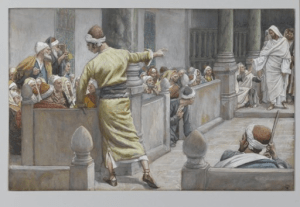
The Healed Blind Man Tells His Story to the Jews

A second time they summoned the man who had been blind. “Give glory to God by telling the truth,” they said. “We know this man is a sinner.” He replied, “Whether He is a sinner or not, I don’t know. One thing I do know. I was blind but now I see!” (John 9:24–25, NIV)

The man had been blind from birth. He lived every day of his life in darkness, unable to do anything but beg for the help and kindness of strangers. But one day, all that changed. It was the day on which the man encountered Jesus Christ. Jesus walked up to the man, spit on the ground, making mud with His saliva. He took the mud, put it on the blind man’s eyes and then told him to go and wash in the Pool of Siloam. The man did as Jesus told him to do and, for the first time in his life, he was able to see (John 9:6-7). He was set free from the prison of darkness by the light of the world.

This healing took place on the Sabbath so, when the Pharisees heard of it, they decided to investigate. They questioned the formerly blind man. They questioned his parents. Then they questioned the man again. They wanted the man to testify that Jesus was a sinner and that the healing was from God, but had nothing to do with Jesus. The man told them that he did not know whether Jesus was a sinner or not. He told them that the one thing he did know beyond a shadow of a doubt was that he had been blind but could now see.

The formerly blind man’s words are echoed in one of the most beloved hymns, “Amazing Grace.”

Amazing grace, how sweet the sound
That saved a wretch like me;
I once was lost, but now I’m found;
Was blind, but now I see.

Don’t you just love that hymn? The words of “Amazing Grace” are such a testimony to the love and grace that God shows to all of us, a love and grace that are demonstrated in the fact that, while we were still sinners, God gave His Son, Jesus, to die for us, so that by believing in Jesus, we can be saved (Romans 5:8; John 3:16).

Because of sin, all of us have been born in darkness, we have been born blind. But, unlike the blind man in John 9, our blindness is not a physical blindness and the darkness we walk in is not a physical darkness. Rather, our blindness and our darkness are spiritual. But, just like the blind man, our blindness can be healed and we can walk in the light because, just like the blind man, we can encounter the healing and saving power of Jesus. Long before Jesus came into the world, Isaiah prophesied that those who walk in the darkness will see a great light, those who live in the dark will have the light shine upon them (Isaiah 9:2). That light is Jesus, the light of the world.

Jesus came as the light of the world so that everyone who believes in Him will no longer live in the darkness of sin (John 8:12). Without Jesus, we are spiritually blind, walking in the darkness that has been created by our sin. Sin causes us to walk in the darkness, where we stumble and get lost. But when we come to Jesus, when we believe in Him, believe that He died for us, and we turn from our sins to follow Him, then we walk in His light. And, when we walk in His light, that darkness cannot overtake us (John 12:35). Without Jesus, we are lost. With Him, we are found. And when we walk with Jesus, the light of the world, like the blind man we can say, “One thing I do know. I was blind, but now I see.”

Be It Ever So Humble, There’s No Place Like Home

Home_Sweet_Home_-_Project_Gutenberg_eText_21566

Many of us love to travel. It’s fun and often exciting to discover, visit, and explore new places. But how many of us would say that we truly love to stay in hotels or motels? I’m guessing that, if you’re like me, a hotel room is not your favorite place to stay. Why? The hotel room may be nice, and it may be quite comfortable, but it’s not home. The same is true for staying with friends or family. While we love catching up with friends and spending time with family, their homes are not ours and, as the words to the song “Home, Sweet Home” say, “Be it ever so humble, there’s no place like home.”

It is said that home is where the heart is. But here’s the thing. We may love our homes, and we may love the towns and the cities that we live in. We may be grateful to God for providing these homes, as of course, we should be. But, as followers of Christ, our earthly homes are not where our hearts should be because this world is not our real home. Rather, our real home is in heaven, in our heavenly Father’s house. In fact, Jesus promised that He was going ahead of us in order to prepare a place for us there (John 14:2). And better yet, Jesus promised that He will one day return and personally escort us to our home, a place where we can be with Him (John 14:3).

Until that time, we live in our earthly homes. But although we are in the world, we must not be of the world. Jesus was not of this world and, as His followers, neither are we (John 17:16). When we confess with our mouths and believe in our hearts that Jesus is Lord, that He is the Son of God, then Jesus abides in us (1 John 4:15) and if He abides in us, then we are not of this world. That is why it is important that we not love this world or the things of this world. In fact, if we love the world, then the love of our heavenly Father is not in us (1 John 2:15). Someday the world will pass away but those of us who love God and do His will shall live forever in the home Jesus has prepared (1 John 2:17).

While we wait for Jesus to bring us into our real home, we must be careful not to conform to the world. Rather, by allowing our hearts and minds to be transformed by the power of the Holy Spirit, we should be transformed so that we are fully able to discern God’s perfect will for us (Romans 12:2). My prayer for all of us is that, while we live in this world, we live lives that are not of this world and that we will all be able to truly say, “There’s no place like home!”

Forget Not All His Benefits

Psalm 1032 [widescreen]

Ever since I first owned a car, I have been a member of the American Automobile Association, more commonly known as AAA. There are many benefits to being a member of AAA. If your car breaks down, they’ll come and tow it. Got a flat? AAA will send someone to fix the flat or change the tire for you. Car stuck in the mud? They’ll send someone to extricate it. The benefits go on and on. I am well acquainted with the benefits of AAA, having used several of the services they offer. And because I have benefited from those services, I am ready to tell anyone who owns a car how much I love AAA and how much I appreciate the benefits they provide to their members.

In Psalm 103, David sings praises to the Lord, blessing the name of the Lord with his whole heart, with his whole being (Psalm 103:1). David knew firsthand the benefits of being a child of God. Having experienced the benefits that God provides, David makes it clear that he will not forget any of those benefits (Psalm 102:2) and that he was ready to tell everyone about them. In verses 3 to 5 of this beautiful psalm, David lists six particular benefits, six blessings that he had received from God, blessings that meant so much to him that he wanted everyone to know about them, to know that they could receive these benefits, these blessings, as well.

The first benefit is forgiveness (Psalm 103:3a). Just like each and every one of us, David was a sinner. But David had experienced the forgiveness of God. In verse 12, David says that God has removed our sins as far from us as the east is from the west. God sent His Son, Jesus, to pay the penalty for our sins, and when we trust in Him and believe in Him, we can experience God’s forgiveness.  The second benefit that David lists is healing (Psalm 103:3b). Isaiah 53:5 tells us that by Jesus’ stripes we are healed. Healing is available to us as believers. God is able to heal every disease. This does not mean that healing is guaranteed, but we must always pray for healing, believing in our hearts that God can and does heal.

The third benefit that David speaks of is redemption. God redeems us from the pits in our lives (Psalm 103:4a). When we are stuck in pits such as depression or addiction, we can be sure that if we call on God, He will reach down and redeem us from those pits. And, because of the sacrifice of Jesus, God has provided a way out of the ultimate pit, the pit of our sins. The fourth benefit that David speaks of is the crown of God’s loving-kindness and compassion (Psalm 103:4b). In the New Living Translation, this is translated as God’s love and tender mercies. God has shown us how great His love is by sending Jesus to die for us (John 3:16) and His tender mercies toward us never fail. Because God is faithful, His mercies and compassion are new every morning (Lamentations 3:22-23).

The fifth benefit proclaimed by David is that God fills our lives with good things (Psalm 103:5a). God knows what we need in life, on both a spiritual level and an earthly level, and His desire is to provide good things for all of us. Jesus taught that we should seek God’s kingdom and God’s righteousness first and, when we do, God will provide the good things that we need (Matthew 6:33). Finally, the sixth benefit David shows us is that God renews our youth like the eagle. This doesn’t mean that God is like the fountain of youth and that we will be made young in our old age. Rather, God makes us like an eagle, which (like most other birds), goes through a process called molting. The eagle sheds its old feathers, feathers that have become worn and damaged, and those feathers are replaced by new, stronger feathers, giving the eagle a renewed strength. That is what God does for us. He helps us to shed the old person, getting rid of the habits and behaviors that drag us down, and replaces them with the new person, filled with the strength that comes from Him, so that we can soar like the eagle.

All of us, when we choose to walk with God, to believe in His Son, Jesus, and follow His ways, can receive the benefits that David speaks of in Psalm 103. And once we receive them, we must never forget them. We must praise the Lord for them and testify to those around us about what He has done for us.


Pride vs. Humility

Pride

In 1993, as I trained to run in the New York City Marathon, I decided to take a special training workshop being offered by the NYC Road Runners Club, of which I was a member. Since I was training to run a marathon for the first time, I thought this workshop would be a great addition to the training I was doing on my own. Plus, the workshop was being given by Bob Glover, a well-known running coach and author of many best-selling books on running. So, I signed up for the workshop and, for several weeks, made a trip into the city to attend.

At one of the weekly sessions of this marathon training workshop, Bob and his assistants took the class to a block on the upper east side that had a very steep hill. Our assignment was to start at the bottom of the hill and run to the top in order to train for some of the hills we would encounter during the actual marathon. The class was broken up into two groups, those who were faster and more experienced, and those who were a bit slower and less experienced. I was in the latter group. The faster group started the drill and then my group was sent up the hill. And this is when I learned the consequence of pride!

Our group started making its way up the hill when a classmate and I thought that they were too slow for us. Pride kicked in and we decided we could run faster than the rest of the group. So, we picked up speed and made it to the top of the hill ahead of the rest of the group. We felt pretty good about ourselves, proud that we had shown we were faster than the rest. That good feeling didn’t last long though as we faced the consequence of our burst of pride. Bob Glover came over to us and told us that, since we were so fast, we now had to move up to the first group, that group of people who were faster runners than we were. I did not enjoy the rest of that class!

Some forms of pride can be a good thing. It can be self-respect that is reasonable. It can be a confidence in others that is justifiable. In 2 Corinthians 7:4 (NLT), Paul wrote about this kind of pride when he said, “I have the highest confidence in you, and I take great pride in you. You have greatly encouraged me and made me happy despite all our troubles.” But there is another kind of pride that is a bad thing, a sinful type of pride that shows itself as improper or excessive self-esteem. That is the type of pride that the Bible warns us about. It is the type of pride that we need to steer clear of.

In the Bible, there are ten Hebrew words and two Greek words translated as pride that refer to an attitude in which a person is exalting himself. There is also another Greek word that refers to a person who is filled with egotism. These types of pride are sins of attitude, sins of the heart and the spirit. These are the types of pride that God hates. In James 4:6, we are told that God is opposed to the proud. In fact, God detests the proud and, as Proverbs 16:5 tells us, the proud will be punished. Jesus taught that the person who exalts himself, the prideful person, will be humbled (Matthew 23:12). I certainly felt humbled that day in my marathon workshop!

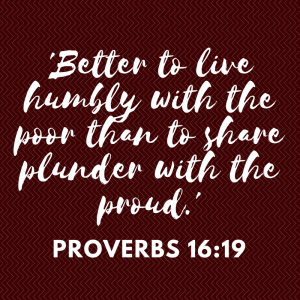
As I learned, pride comes with consequences. In Proverbs 16:18 (NLT), we read that “Pride goes before destruction, and haughtiness before a fall.” Clearly, pride is something to avoid at all costs. Instead, we must choose humility. We must humble ourselves, putting the needs of others ahead of our own. While there are consequences to pride, humility brings blessing. God opposes the proud, but He exalts the humble (Matthew 23:12) and gives them grace (James 4:6). When we, in humility, submit ourselves to God, He gives us the ability to resist the devil (James 4:7). And God’s Word promises that when we humble ourselves before Him, He will exalt us (James 4:10).

What is Man?

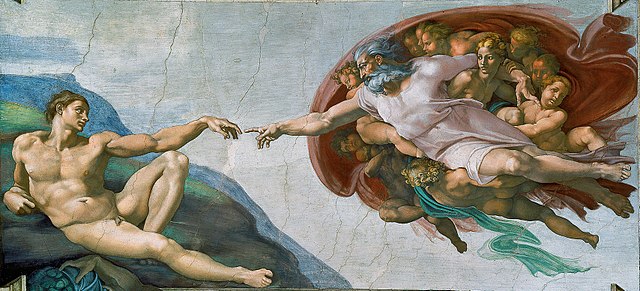
640px-Creación_de_Adán_(Miguel_Ángel)

What is man that You take thought of him, 
And the son of man that You care for him?
Yet You have made him a little lower than God, 
And You crown him with glory and majesty!
(Psalm 8:4–5)

In Psalm 8, verses 1-3, David starts off by talking about the majesty and splendor of God, then reflects upon all that God has created. He thinks about the incredible work of God’s hands, which includes the heavens, the moon, and the stars. And then, David poses a very good question when he asks, “what is so important about man that God should think so much of him?” God created everything, the earth, the sun, the moon, the entire solar system. He created the mountains, the valleys, the trees, and the amazing variety of the plant-life we see around us. He created the ponds, the lakes, the rivers, and the mighty oceans. He created the birds, the fish, and the rest of the incredibly diverse creatures that walk the earth. So, David asks, why is man so special?

David ponders this same thought in Psalm 144:3-4, when he says, “O LORD, what is man, that You take knowledge of him? Or the son of man, that You think of him? Man is like a mere breath; His days are like a passing shadow.” As I said before, it’s a very good question. Why is man so special to God? Before I looked for the answer to that question, as I read Psalm 144:4, I was struck by one phrase, “Man is like a mere breath.” The Hebrew word translated as “breath” here is the same word that is translated as “vanity” or “meaningless” in Ecclesiastes 1:2. In comparison to God, in comparison to the vastness and wonder of God’s creation, what is man? Is man really meaningless? Is man mere breath?

Just like the rest of the creatures that roam the earth, man was created from the dust of the ground (Genesis 2:7,19). But, there was something different in the way that God created man, something that set man apart from the rest of creation. First, when creating man, God said, “Let Us make man in Our image.” So, unlike all the rest of creation, when man and woman were created, they were created in the image of the Creator, in the image of God. Creation as a whole reflects God’s creativity, the incredible workmanship of His hands. But man and woman reflect God Himself.

When God created everything else we see around us, He said, “Let there be…” and then those things were created. But when God created man from the dust of the earth, He did something He had not done with any other creature. He breathed His breath, the breath of life, into man, who then became a living being (Genesis 2:7). Man’s breath, our breath, comes from God. So, the next thing that sets man apart from the rest of creation is that man has the breath of God in his lungs.

After creating man and woman, God blessed them, commanded them to be fruitful and multiply, and gave them dominion over the earth (Genesis 1:28). So, clearly, in God’s eyes, man is far from meaningless, far from “mere breath.” Man is created in His image, has God’s breath in his lungs, and has been given dominion over the rest of creation. And, since man is so special in God’s eyes, since God has set man apart from the rest of creation, man’s purpose is to give Him glory. When we think about how special we are to Him, when we stop to consider how He has blessed us, how can we not desire to do just that, to give Him the worship and the glory that He deserves?

Scripture taken from the NEW AMERICAN STANDARD BIBLE®, Copyright © 1960, 1962, 1963, 1971, 1972, 1973, 1975, 1977, 1995 by The Lockman Foundation. Used by permission.

Always Let the Bible be Your Guide

the-holy-bible

One of my absolute favorite Disney animated films is Pinocchio. You probably know the story. An old wood-carver named Geppetto, who has no children, carves a wooden puppet that he names Pinocchio. That night, in response to Geppetto’s wish upon a star, the Blue Fairy appears and brings Pinocchio to life. She then promises Pinocchio that he can become a real boy if he proves himself brave, true, and unselfish, and she appoints a cricket named Jiminy to be Pinocchio’s conscience since, as a wooden puppet, he doesn’t have one of his own. In the song, “Give a Little Whistle,” Jiminy Cricket tells Pinocchio that whenever he finds himself in a spot where he doesn’t know right from wrong, all he needs to do is whistle and let his “conscience” be his guide. Of course, Pinocchio doesn’t listen to his “conscience” and throughout the story ends up in one predicament after another.

We all have times in our lives when we need to make decisions, to choose the right actions versus the wrong actions. For a believer, those decisions are particularly important as we strive to live righteously, to become more like Christ. When faced with the need to differentiate between right and wrong, we can use human reason. Now, when it comes to the affairs of our everyday life – what to eat, what to wear – there is nothing wrong with using our human reason. But we all make mistakes, so human reason is not the best authority in determining right from wrong.

When choosing between right and wrong, we can also turn to our human conscience. The conscience is an internal voice that basically is our right and wrong indicator. It weighs the situation and steers us one way or the other. The problem is that, because of sin, our conscience has been damaged. We can’t rely on it to steer us in the right direction. We can’t rely on it to make the correct choice between right and wrong. Jeremiah 17:9 (NIV) tells us that “the heart is deceitful above all things and beyond cure.” The Hebrew word translated as heart refers to a person’s inner life. That includes the will, thoughts, motivations, feelings, and, yes, the conscience. Our conscience is not the best authority in determining right from wrong.

So, where should we turn when we need to make decisions, to determine right from wrong? We should turn to Scripture, to God’s Word, the Bible. 2 Timothy 3:16 tells us that Scripture is inspired by God. It is useful for teaching us the truth, what is right, and to show us what is wrong and correct us when we are leaning toward what is wrong. And this is true, not just of some Scripture but ALL of it. When it comes to matters of faith and conduct, the Bible should be our ultimate authority in life. Through the Scriptures, God has revealed to us all that we need to believe.  And, how we live our lives, the standards that we follow as we strive to live righteously, must be dictated by the Scriptures.

Unlike human reason or human conscience, God’s Word is infallible, which means it is incapable of error. And God’s Word is inerrant, which means it does not contain any error. God’s Word is infallible and inerrant because God Himself is perfect. And so, to paraphrase Jiminy Cricket, as we go through life and need to determine right from wrong, we must always let the Bible be our guide.